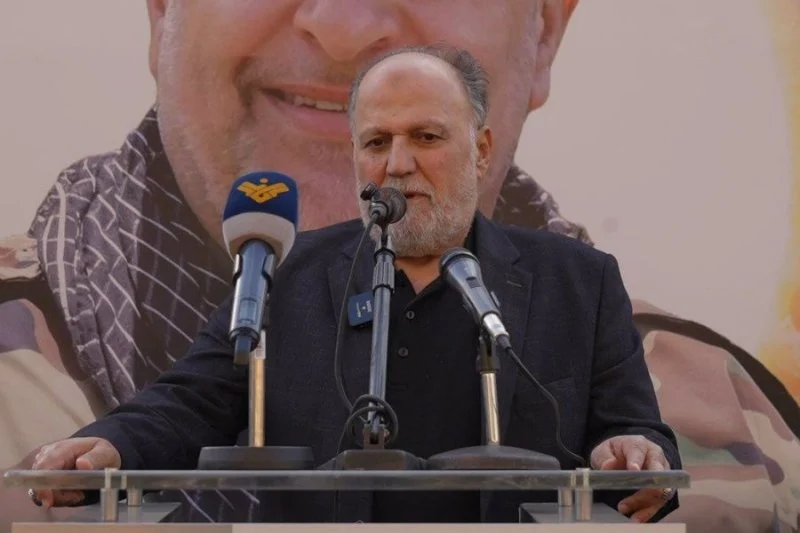
Representative Ali Ammar, a member of the Loyalty to the Resistance Bloc, stressed on Tuesday, February 17, 2026, “the need for the state to carry out its responsibilities and duties,” considering that addressing living problems by draining citizens’ funds is a “wrong approach” to internal issues, especially in light of the delayed disbursement of salaries and their weak value.
Ammar’s statements came during the unveiling ceremony of the memorial to the martyr jihadi leader Hajj Ali Abdel Moneim Karaki (Hajj Abi al-Fadl), which was organized by the Haret Hreik municipality on Al-Amliyeh Street, at the site of his martyrdom, in the presence of Hezbollah Political Council member, former minister Mahmoud Qamati, the deputy mayor of Haret Hreik Sadiq Slim, the martyr’s family, a number of clerics, officials and figures, and a group of people.
Ammar said that the talk about Abu al-Fadl is a talk about “a precedent in the virtue of jihad,” explaining that he had the spirit of a leader and longed for martyrdom from his early days, and that he and his companions formed the first nucleus of the resistance movement before it developed into an integrated organization and movement.
Regarding the sovereign issue, Ammar pointed out the continuation of what he described as the “malice of the Israeli enemy” and its attempts to violate sovereignty, through new settlement steps in the south, such as planting trees inside the border fence. He added that betting on diplomatic solutions took time, “more than a year,” without succeeding in stopping the attacks.
Ammar stressed that the experiments proved, as he said, the unity of interests between the United States and “Israel,” considering that they represent the height of aggression and a threat to sovereignty. He concluded his speech by emphasizing that protecting the sovereignty and preserving the dignity of the Lebanese army is the duty of the state, warning of the internal political restrictions that prevent the army from carrying out its duties in the face of attacks.
Representative Ali Ammar’s statements come in the context of an increasing internal debate over economic and tax policies, coinciding with escalating sovereignty and security tensions on the southern border, where accusations of violating the ceasefire agreement are repeated. In this context, the role of the state and the army, and the limits of diplomatic solutions in stopping attacks, are discussed again, in exchange for calls to adopt more effective approaches to protecting sovereignty.