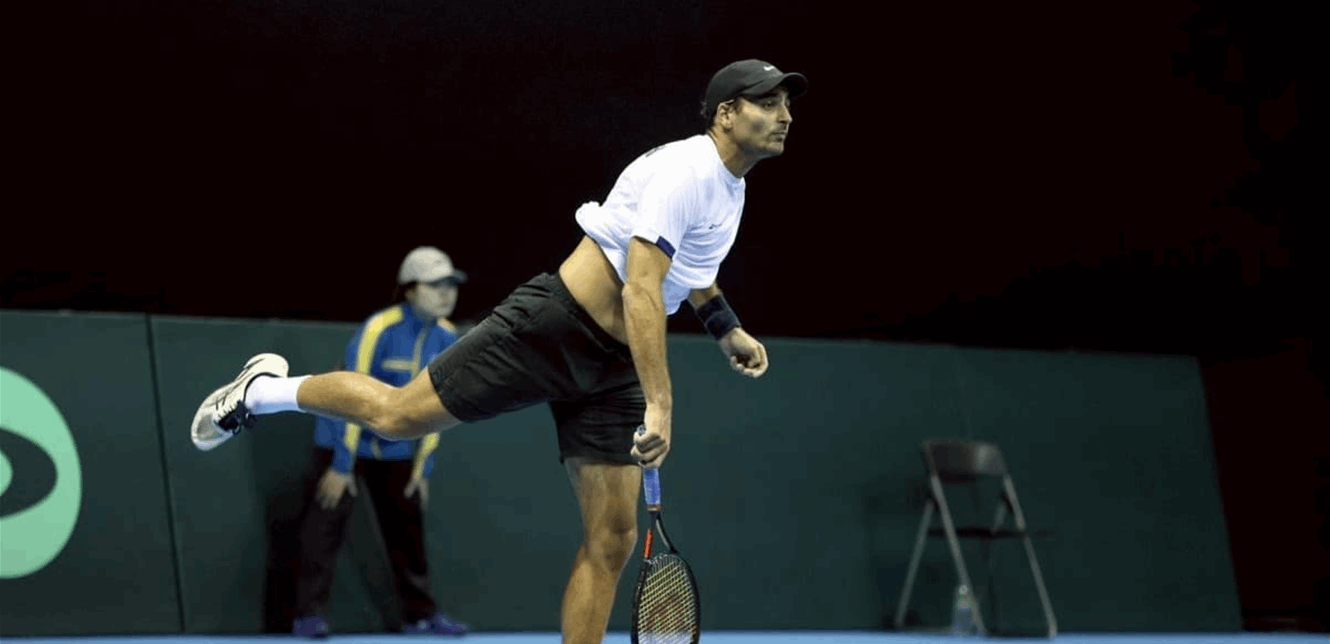
Lebanon’s 3-1 loss to Taiwan in the Davis Cup was not just a passing event in a sporting schedule full of football and basketball. It is a unique competition, calculated in “points” but often decided by “details” that do not appear in the final result alone. On February 7 and 8, 2026, at the “Taipei Tennis Center” within “World Group I”, the confrontation ended in favor of the hosts, while Lebanon achieved a single victory in the singles on the first day, before Taiwan imposed its control on the second day.
The beginning of the match showed that Lebanon is capable of competing with an opponent who is not far behind in level. Taiwan advanced first with Tong-Lin Wu defeating Hadi Habib in two sets to zero with a score of 6-3 and 6-2, but Benjamin Hassan brought the match back to a draw point by defeating Tsung Hao Huang in two sets 6-4 and 6-4, ending the first day with a 1-1 draw.
The impression after the first day was simple: Lebanon is present, the differences are not large, and the possibility of surprise is possible. But the Davis Cup is not that simple. The “turn” came on the second day of the doubles match, when the Taiwanese duo won the match over the Lebanese duo with a score of 7-6 and 6-3, a result that seemed close on paper, but in practice it was a morale blow before the decisive singles match.
Taiwan then wrapped things up by winning the final singles to make the overall score 3-1.
Where do teams appear in national team matches?
In club competitions, course correction can occur over the course of a long season. In the Davis Cup, one week can determine the course of the entire stage. So, when the host leads 2-1 after doubles, the pressure turns into a test of nerves that is no less important than the technical level. Specifically here, the question of “preparation and continuity” arises, which imposes itself outside of football and basketball. The point is not that Lebanon was not prepared, as evidenced by the draw on the first day, but the point is that the teams that live on a fixed routine, and have a regular program of camps, experienced doubles, and exchanging roles, manage difficult moments well.
The clearest lesson from this matchup is that doubles at Davis is not a secondary station. One match could shorten the course of days. The details of the tiebreak, and then the ability to “pin” the second set, were the shortest path for Taiwan to the lead point. From here, the 3-1 story becomes more than just a loss. It is a reminder that investing in a stable “pair” and repeating harmony in doubles is not a luxury for teams looking to advance to higher levels, because these matches are not always decided by the most prominent names in singles only.
Lebanon emerged from Taipei with a loss, but also with a practical indication of where the focus should be. In a country where football and basketball consume the limelight and resources, other team sports seem to demand only the “minimum” of continuity. But the Davis Cup in particular is unforgiving to this logic. Because one match can shorten an entire season, and because a victory on the first day does not turn into an achievement unless there is something to protect it on the second day. Lebanon did not lose only 3-1. He lost a “detail” in which he needed small points to accumulate victories and reduce the cost of details. Taiwan won because it managed the details properly, in the place and time in which this type of confrontation was resolved.