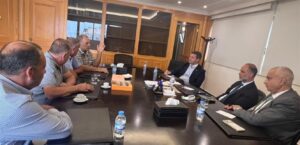
The Konrad Adenauer Institute held a dinner in honor of Minister of Industry Joe Issa El-Khoury, in the presence of representatives from the German Parliament visiting Lebanon, in addition to a number of political and economic figures.
In his speech during the dinner, Issa Al-Khoury stressed that “a historic friendship brings together Lebanon and Germany, based on shared values of steadfastness, productivity, innovation, and respect for human dignity.”
He stressed the importance of developing the partnership between the two countries to go beyond traditional relations towards strategic industrial cooperation that serves stability and mutual growth.
He pointed out that the presence of German officials in Beirut represents a strong and positive message that reflects Germany’s interest in Lebanon and its future. He also expressed his appreciation to Germany for its continued commitment to supporting peace and stability in southern Lebanon, through its effective contribution to the United Nations Interim Force in Lebanon (UNIFIL), through the participation of its ground and naval forces in operations to maintain maritime security through patrols, training and surveillance, and building the capabilities of the Lebanese Navy, in addition to helping to implement the United Nations resolution related to monitoring the ceasefire and borders.
The Minister of Industry stressed that Germany’s contribution to UNIFIL is not limited to the military aspect only, but also represents a clear message of solidarity with the Lebanese people, aiming to strengthen Lebanon’s sovereignty and security, considering that this long partnership in peacekeeping operations reflects Germany’s firm commitment to Lebanon’s stability and security.
He addressed the future of Lebanese-German relations, stressing the need for them to be of a primarily economic nature, especially in the industrial field. He said: “Germany is a leading global power in the field of industrial technology, from advanced manufacturing and precision engineering, to automation, robotics, and environmentally friendly production, all the way to the Fourth Industrial Revolution (Industry 4.0), which is essentially a German government initiative aimed at promoting interconnected manufacturing and digital integration between industry, companies, and all other operations.”
On the other hand, Issa Al-Khoury pointed to the strategic advantage that Lebanon enjoys, represented by the energies of educated youth, who are distinguished by their multilingualism and highly qualified engineers, programmers, designers and technicians who are able to compete globally, and who grew up in an environment that stimulates innovation and the spirit of initiative, considering that this integration constitutes a natural basis for a promising partnership between the two countries.
He added: “My vision is clear: Lebanon can become Germany’s platform for technological industries due to its proximity to production and marketing sites in the Middle East, and be a center through which German companies can: establish technology and engineering offices, develop software and industrial design, conduct research and development, assemble high-value components and serve regional markets in the Middle East, Africa and even Europe, at competitive costs and in accordance with European standards in terms of efficiency and quality. In short: German technology, Lebanese talent and shared growth.”
He explained that the Ministry of Industry is currently working in this direction, by modernizing infrastructure, digitizing procedures, developing industrial technology zones, supporting advanced manufacturing, and enhancing export capacity, stressing that Lebanon is not asking for aid, but rather offering partnerships based on real investment opportunities.
Issa Al-Khoury concluded his speech by emphasizing that Lebanon and Germany share the knowledge of how to rebuild and transform difficulties into opportunities, and that industry is not just factories, but rather a pillar of human dignity, creating job opportunities, and promoting innovation and stability. From this standpoint, he called for moving from good relations to strategic relations, from trade to joint production, and from friendship to common prosperity.