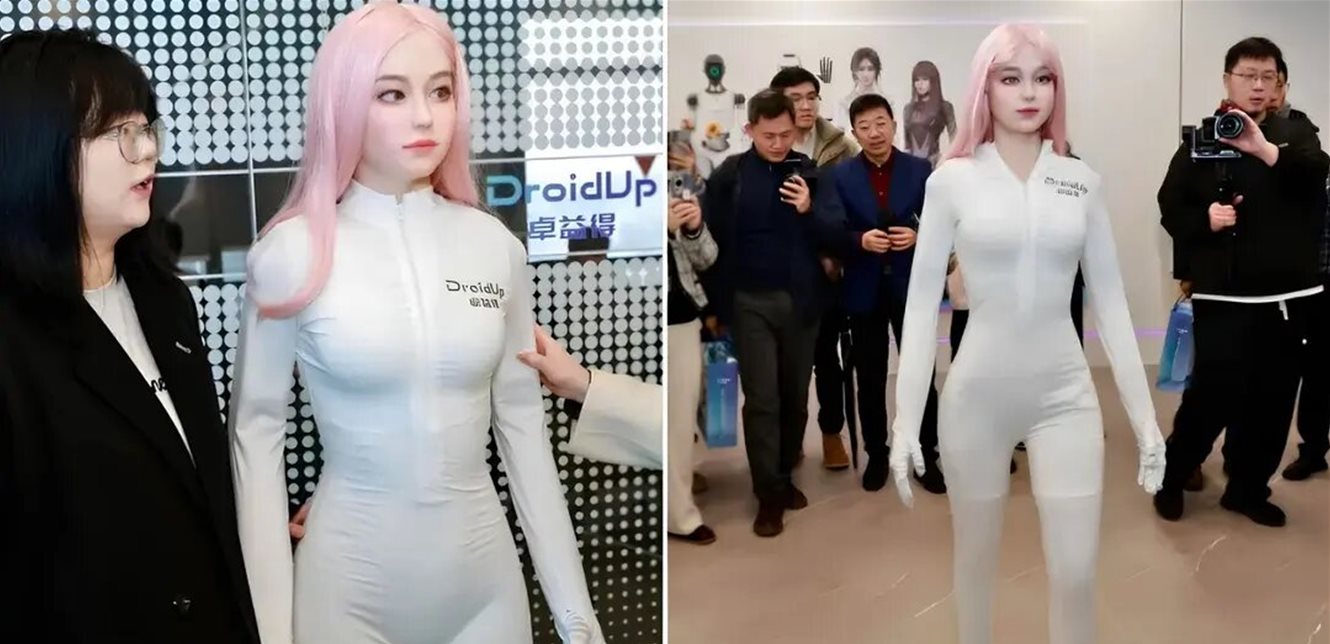
In Shanghai, the Chinese robotics company “DroidUp” announced its humanoid robot “Moya,” describing it as the world’s first robot that relies entirely on the concept of “embodied artificial intelligence and biological simulation,” representing a qualitative shift in human-machine interaction.
The robot has received great attention on Chinese social media, after videos spread showing its ability to walk in a very human-like way, while maintaining eye contact and showing subtle facial expressions such as smiling and nodding.
Moya is based on the concept of “Embodied AI,” which is not limited to digital processing, but rather integrates perception, thinking, and execution into the physical world. According to the manufacturer, the robot can simulate “micro-expressions,” making it among the most realistic humanoid robots to date.
### Specifications approaching human
The robot is 1.65 meters long and weighs about 32 kilograms, with dimensions that mimic the body of an adult human. Its structure maintains a temperature between 32 and 36 degrees Celsius, in an attempt to enhance the sense of human presence during direct interaction.
DroidUp also announced that Moya’s walking posture accuracy is “92%” compared to human movement, reflecting the company’s focus on stability and flexibility rather than speed or athletic performance.
### Different interactions and the “Valley of Strangeness”
The robot’s appearance and behavior sparked different reactions among followers; While some expressed their admiration for its realism, others showed a feeling of suspicion and uneasiness, which embodies what is known as the “Valley of Strangeness,” which is the psychological state in which a person feels aversion to artificial beings that are very close to the human form but are not completely human.
According to technical reports, Moya relies on a platform known as “Walker 3,” but DroidUp did not officially disclose the technical details of this platform, nor did it confirm the existence of any connection between it and other robotic platforms of the same name developed by other companies.
### Uses beyond industry
The company is not marketing the robot as an industrial tool, but rather sees it as suitable for sectors such as “healthcare, education and commercial environments” that require long-term human interaction and a sense of familiarity.
The Moya is expected to enter the market by “the end of 2026,” with an initial price tag of about “1.2 million Japanese yen,” according to media reports, with final details to be announced at a later date.
The post Inauguration of the first “biologically simulated” artificial intelligence robot appeared first on 961today Lebanon Today.