January 27, 2026
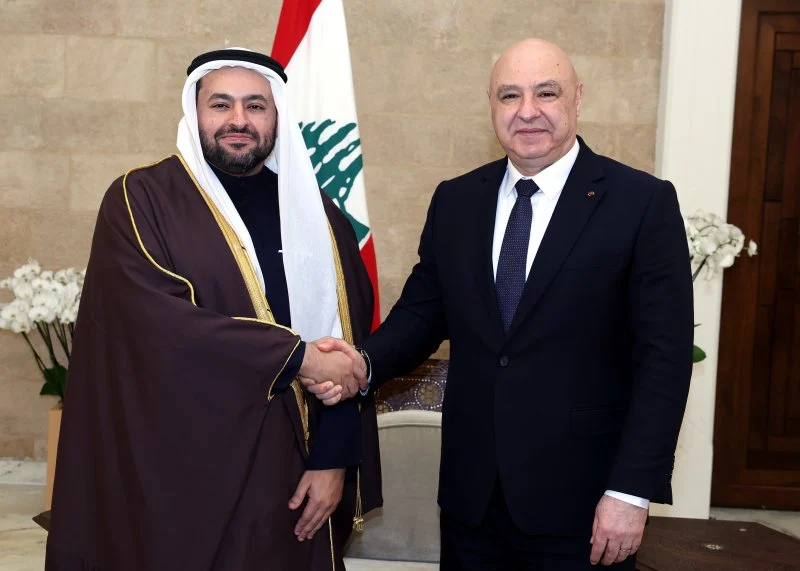
The Minister of State in the Qatari Ministry of Foreign Affairs, Mohammed bin Abdulaziz Al-Khulaifi, told Al-Modon website that the meetings he held with Lebanese officials were of great importance, especially at this sensitive time that is witnessing escalation in the region. He stressed that the State of Qatar attaches great importance to monitoring the situation in Lebanon and supporting de-escalation initiatives, while emphasizing its rejection of escalation and striving diligently to prevent it.
Al-Khulaifi indicated that his meetings focused on providing support and assistance in various fields, which was emphasized during the meetings, especially the meeting held in the Grand Serail, which was divided into two parts: the first was a meeting with the Prime Minister, Nawaf Salam, and the second was an expanded meeting that included the Prime Minister and a number of ministers, most notably the Deputy Prime Minister, Tariq Mitri, and the ministers of Foreign Affairs, Finance, Health, Economy, Energy, Public Works and Transport, and Youth and Sports.
The Minister stressed that the Prime Minister expressed a clear interest in expanding the scope of cooperation with Qatar in various sectors, working to remove any obstacles, and taking all necessary measures to facilitate joint projects, especially in the fields of health, education, supporting emerging groups, and energy. In this context, he explained that the State of Qatar is providing a grant worth $40 million to support the electricity sector, in addition to an additional economic project worth $360 million to support the same sector, benefiting about 1.5 million subscribers in most Lebanese regions.
Regarding the security aspect, the minister stressed that Qatar believes that the Lebanese army represents the basic foundation for protecting Lebanon, its sovereignty and unity, considering that supporting the army is necessary as it is the pivotal national institution that provides the umbrella of security and stability. He explained that this approach enjoys the support of the countries that are preparing to hold a conference to support the army in Paris, preceded by a preparatory meeting in coordination with the five countries. Although the place and date of the preparatory meeting were not specified, he stressed that Qatar welcomes hosting it and expresses its readiness to participate in it in any place agreed upon, pointing to the continued Qatari support to strengthen the status of the army and attention to the salaries of its members.
Regarding the file of displaced Syrians, Al-Khulaifi explained that the project began with a first phase that includes the return of 100,000 refugees, to be followed by later stages to return 400,000, leading to the effort to return all the displaced. He pointed out that the project includes multiple aspects, the most important of which is enhancing security, providing conditions for the returnees’ integration into their society, and securing food and medicine during the first months of their return, in coordination between Lebanon and Syria, stressing the achievement of tangible successes in this path.
The minister added that the reconstruction file, although not explicitly announced, remains essential and has been discussed with Lebanese officials, noting that it requires a clear political path, establishing security stability in the south, and preventing attacks. He explained that work is underway to reach a formula that guarantees security and stability, allowing the launch of the reconstruction path, citing what happened in Gaza, where the path begins by addressing the security situation and stopping the war, then moving to political solutions, leading to reconstruction.
Al-Khelaifi also revealed contact with the five countries concerned with Lebanon in order to implement the ceasefire agreement, noting the need to establish a clear mechanism for its implementation. He pointed out that the political consultations are divided between communication with the Lebanese parties and with the quintet, with the aim of developing a common vision for de-escalation initiatives, especially since any regional calm directly affects Lebanon.
The Minister concluded by emphasizing the existence of common international and regional concern about the possibility of escalation, considering that regional tensions raise concern because of their direct impact on Lebanon, and that any escalation will reflect negatively on it. He stressed that Qatar continues its role of encouraging dialogue and reducing escalation, through its relations and communications, especially with the Americans and Iran.