The State of Qatar has strongly entered the line of support for Lebanon with a major financial and development initiative, worth approximately $400 million. This step reflects a forward-looking outlook aimed at supporting stability and enhancing economic and social resilience, rather than providing temporary aid.
According to diplomatic sources, Doha was keen that its move be part of a coordinated international effort to ensure the effectiveness and continuity of the initiative. This confirms that the Qatari approach relies on a practical vision that takes into account Lebanese internal balances and complex regional circumstances.
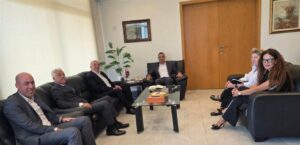
The visit of the Qatari envoy, Minister of State in the Ministry of Foreign Affairs, Mohammed bin Abdulaziz Al-Khulaifi, to Lebanon received great official attention.
At the Palace, during a joint press conference with Deputy Prime Minister Tareq Mitri, the Minister of State in the Qatari Ministry of Foreign Affairs announced a group of projects in Lebanon in cooperation with the competent authorities, including economic sectors, providing $40 million to support the electricity sector, and another economic project that supports the sector with $360 million, in addition to the project to rebuild Karantina Hospital, which was damaged by the explosion.
In response to a question, Al-Khulaifi stressed that “there is nothing that limits Qatar’s aid to Lebanon and its people, and there are consultations and research with Lebanese officials and five-party discussions are ongoing in Lebanon or in Doha.”
He said: “We reaffirmed Qatar’s full support for the army and stressed the necessity of implementing Resolution 1701. We also renew our condemnation of the Israeli attacks on Lebanese territory and stress the need for the Security Council to assume its responsibilities to stop them,” stressing that Qatar’s continued support for the Lebanese army stems from the fact that this institution constitutes the security and stability of Lebanon. He added: “Qatari support for Lebanon has no limits, and the aid is being evaluated and discussed with the Lebanese state, and new initiatives will be revealed.”
As for “Mitri,” he pointed out that “Qatar supports Lebanon in various sectors, especially political support and reconstruction after the July War, and it stands by Lebanon and affirms the imposition of its sovereignty over its land and its liberation from occupation,” stressing that “the Qatari political position is known and goes hand in hand with support for the army.”
Al-Akhbar wrote: “The visit of the Minister of State for Foreign Affairs of Qatar, Mohammed bin Abdulaziz Al-Khulaifi, to Beirut was the most prominent event, not only in terms of its timing, but also in terms of its content and the messages and initiatives carried by the Qatari envoy. It constituted a surprise that prompted some political circles to search into the backgrounds of the sudden opening of the door to assistance.”
Al-Khelaifi announced a package of aid and development and humanitarian projects, stressing that Qatar “stands by Lebanon’s belief in the importance of its stability and recovery as a fundamental pillar of the region’s stability.” However, this new momentum remains questionable, in light of the American-Israeli position rejecting any support for Lebanon before the resistance is completely disarmed. What made it even more surprising was that Qatari officials had previously confirmed “that there is no room for providing aid, especially in the reconstruction file, given that support for Lebanon remains dependent on a major regional settlement.”
According to available information, the change in the Qatari position began some time ago, with a Saudi decision to open a new page with Qatar regarding Lebanon. This shift is linked to an understanding with the United States regarding a financially and politically supportive Qatari role.
The Saudi envoy, Yazid bin Farhan, who visited Lebanon about two weeks ago, confided in front of a group of politicians that “an aid package will arrive in Lebanon, and that there is a Saudi-Qatari agreement on this file.”
The circles expected that “the Saudi position is due to Riyadh’s fear of the scenario of chaos on the Lebanese scene, which is the most disturbing possibility for it in the region,” which also explains its position on the war against Iran and its support for the stability of Syria. A deputy was quoted as saying that “Ibn Farhan” confirmed that “the role that Qatar will play is fully coordinated with Saudi Arabia and serves the strategy itself.” According to circles, this agreement comes “in support of the authority in Lebanon, and to encourage it to continue implementing the government’s plan, whether related to the arms issue or reforms,” which is what “Al-Khulaifi” expressed by saying, after his meeting with Prime Minister “Nawaf Salam,” that “the time has come for Lebanon to recover, progress, and grow.”
It was learned that the issue of rebuilding some southern villages damaged by the aggression was up for discussion before Al-Khulaifi’s visit, but it was ignored at the last minute, and it is likely that the reason is due to the United States not encouraging this step at the present time.
On the other hand, the information indicated that the Qatari side came bearing an official decision agreed upon with Saudi Arabia, the United States, and Syria, aiming to finance the process of returning about 400,000 displaced Syrians to their country during the current year. This process includes providing aid for the reconstruction of Syrian towns inhabited by these displaced people, in addition to granting direct aid to facilitate their movement to Syria.
Al-Nahar wrote: Internal developments did not obscure the important and prominent development that accompanied Qatar’s progress once again into an initiative that broke through many of the harsh conditions besieging Lebanon, by providing the largest package of aid and donations to Lebanon in many vital sectors, which is considered the forefront of the largest dose since Qatar played a fundamental role in the reconstruction of southern towns and villages after the 2006 war. Perhaps what is striking is that the Qatari initiative was not limited to the dose supporting Lebanon developmentally. And not only economically, but it seemed closely linked to political connotations.
“Nidaa al-Watan” wrote: The Qatari minister’s visit fell at this particular time, in a broader Arab and international context, confirming that Lebanon is still in the circle of care and attention, provided that its leaders and officials demonstrate their ability to help themselves first. According to follow-up circles, “The basic message that the visit carried was based on a clear equation, which is that the more the Lebanese progress in shouldering their national responsibilities, the more the brotherly and friendly abroad opens the doors of support without hesitation, which is reflected in the renewed Qatari presence as a country that played pivotal roles in previous Lebanese stations and is returning today with practical momentum.”
The circles explained that “what Al-Khulaifi announced as the first aid and projects cannot be separated from being a direct political message to the various official and political leaders, regardless of their orientations, that the opportunity is available today more than ever before to break away from the logic of conferences and deferred promises. To proceed with the implementation of the commitments made by the government, especially what was stated in its ministerial statement and its subsequent decisions related to extending the state’s authority over its entire territory, restricting weapons and the decision of peace and war to the hands of legitimate institutions, in addition to launching a path A serious reform is sufficient to quickly move Lebanon from the category of requesting support to the category of direct investment partnerships. In this context, the Arab countries, along with friendly countries, appear ready to immediately enter into projects and investments capable of bringing about a qualitative shift in economic recovery and development, without waiting for traditional support conferences that often collide with disruptive conditions.”