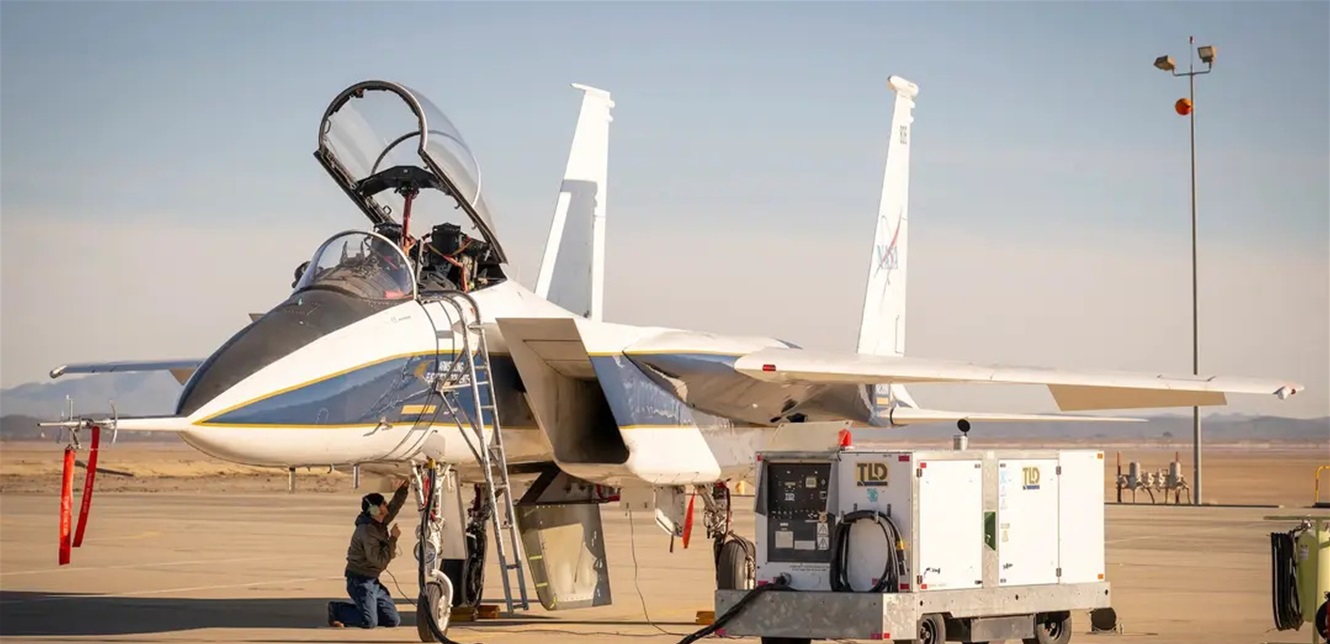
A team of researchers at NASA conducted an experimental test called “Fast Taxi” for an aircraft, using a scaled-down model of an aircraft wing. This test is expected to significantly enhance the efficiency of aircraft, as well as reduce fuel consumption and related costs.
The test was performed on a 3-foot-long wing model, which was mounted under an F-15 test aircraft. The aircraft’s speed during the test reached approximately 144 miles per hour (231 km/h) without taking off, which is considered an important initial achievement at this stage of the test.
The Crossflow Attenuated Natural Laminar Flow (CATNLF) test aims to increase the smoothness of airflow over the wing surface, thereby reducing air resistance known as “drag.” This would improve the aircraft’s aerodynamics and reduce fuel consumption. This design is based on previous studies conducted by NASA between 2014 and 2017, which indicated that a wing designed with CATNLF technology on a Boeing 777 could save up to 10% of fuel consumption, representing millions of dollars in savings annually for commercial airlines.
“Even small improvements in efficiency can lead to significant reductions in fuel consumption and emissions for commercial aircraft,” said Mike Frederick, principal investigator at NASA’s Armstrong Flight Research Center.
The CATNLF system focuses on enhancing the laminar flow of air within the boundary layer very close to the aircraft’s surface, reducing friction and drag, and making flight more efficient. Following the success of the ground test, NASA has now begun conducting flight tests, using an F-15 aircraft as a low-cost model compared to building a complete aircraft equipped with a CATNLF wing.
Initial flight tests are expected to begin in the coming weeks to assess the wing’s performance and capabilities under actual flight conditions. NASA confirms that this new technology could achieve significant fuel savings for commercial airlines, especially with the number of commercial aviation passengers expected to double within 20 years, according to estimates by the International Civil Aviation Organization.
Frederick noted that the technology will have a greater impact on subsonic aviation currently, but it could also pave the way for future applications in supersonic aviation.