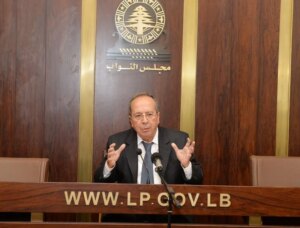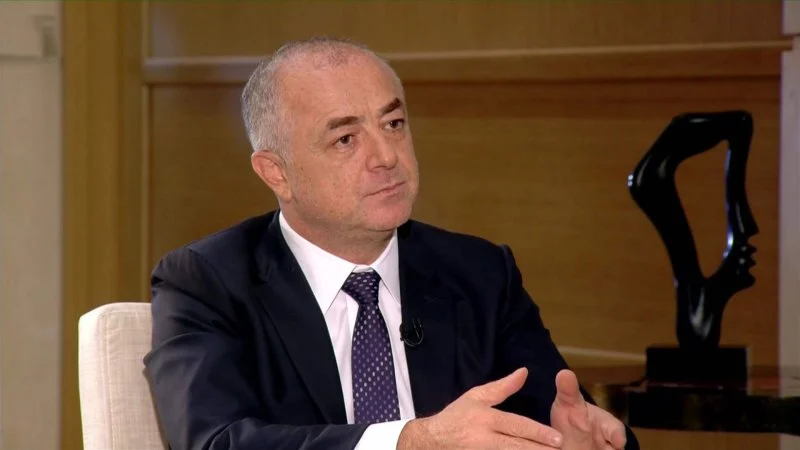
Deputy Speaker of Parliament Elias Bou Saab affirmed, after meeting Speaker of Parliament Nabih Berri in Ain El-Tineh, that the parliamentary elections will be held next May, based on the current, effective law, warning that any change in this law will inevitably lead to the postponement of the elections. Bou Saab told “Al-Diyar”: “I had previously suggested, a year ago, that the parliamentary election law be put under study and discussion, to reach a law that does not change with political circumstances and is not tailored to the measurement of political and sectarian interests.”
Bou Saab pointed to a previous initiative of his, aimed at fully implementing the Taif Agreement, and not selectively in a way that serves the interests of a specific group, noting that the agreement includes a clause aimed at removing the election law from sectarianism and establishing a senate representing all sects and defining its powers. He explained that this path has not been completed, stressing his insistence on “putting the terms of the agreement into full implementation after 36 years of its issuance.”
He described the current law as “lame and enshrining sectarianism,” considering that it revealed many loopholes, and that any amendment to it requires setting a new deadline for the elections, which is something that requires internal consensus that is not currently available. He added that “the ball is in the government’s court, not the Parliament,” calling on the government to activate its powers by opening the door for candidacy 90 days before the election date, and inviting the electoral bodies two months before they are held.
At the same time, the deadline for the Ministry of Interior to open the door for candidacy and invite the electoral bodies to vote is approaching, which is legally scheduled for May 21, that is, 10 days before the end of the Parliament’s term on May 31 of this year. Interior Minister Ahmed Hajar announced that he will implement what is required of him by law, and he has already begun to do so by inviting Lebanese expatriates or those in the diaspora to register their names in cooperation with the Ministry of Foreign Affairs, in accordance with Articles 113 and 123 of the law, with registration ending on November 20.
It is worth mentioning that the current law is Law No. 44 dated June 17, 2017, which was the basis for the 2018 and 2022 elections with some exceptions, after the extension of Parliament in 2013 for reasons that were said to be technical. Today, the issue of a “technical extension or postponement” is being raised to allow expatriates to visit Lebanon during the summer to cast their votes inside the country. However, there is a dispute over this issue between a team that demands that expatriates vote for all 128 deputies in their places of residence, and another team that affirms that the law has preserved their representation in accordance with Article 112, which created their special District 16.
Bou Saab pointed to the limited time to make any amendment, noting that the draft and proposed laws referred to Parliament are in the Administration and Justice Committee and the sub-committee emanating from it, but its work is disrupted due to differing opinions and each team adhering to its position. He believed that this situation requires the government to implement the law, and the Ministry of Interior to activate its powers, which Minister Hajar has begun to do.
He stressed that postponement is not on the table, explaining that amending the election law in light of the political division and lack of consensus is what may lead to postponement. He concluded by saying that the solution lies in holding elections according to the current law until a law that is not based on sectarianism is reached, considering that this is possible by returning to the Taif Agreement, which has become part of the constitution and introduced reforms to the political system, starting with the abolition of sectarianism in jobs except for the top categories, up to balanced development and administrative decentralization, and the exclusivity of weapons in the hands of the state and the dissolution of militias, considering that what happened was a selective application of the agreement according to interests.
He concluded by confirming that “the elections will take place on time, and that any amendment to the election law inevitably means an amendment to the deadlines set for holding them.”