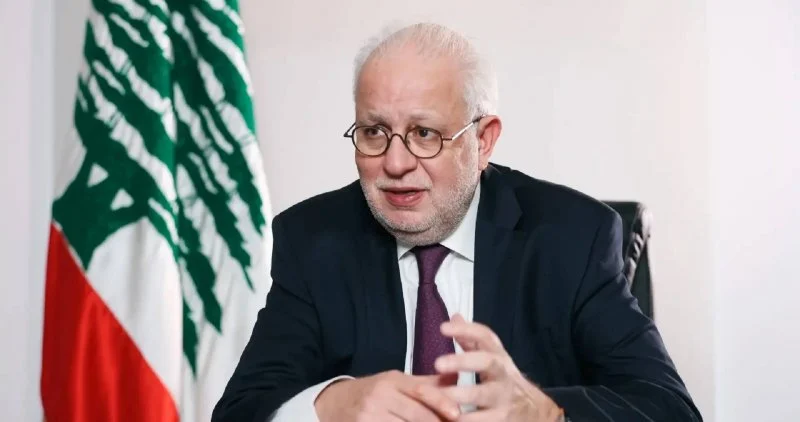
Justice Minister Adel Nassar explained in an interview on the “Saraya Dialogue” program on “Lebanon TV” that his objection to the appointment of Gracia Al-Qazzi as Director-General of Customs was not personal, but based on the inappropriateness of the timing given the existence of sensitive judicial files, especially the Beirut port explosion file.
He added that the presumption of innocence is protected, and that any ministerial decision does not affect the course of judicial investigations, stressing the independence of the judiciary. He pointed out that his objection was to the suitability, not to the existence of a legal impediment, and that the Council of Ministers saw by a majority that the appointment was permissible, and that it was an administrative decision that did not aim to restore honor or affect any file under investigation.
He considered that the movements of the families of the port victims, despite their human legitimacy, should not be understood as a change in the course of justice or interference in the investigations. Regarding state-building, he affirmed that national sovereignty and the exclusive power of the official authorities are fundamental, with the need for everyone to be subject to the law and to unify the legal force in the official institutions to address political and security accumulations.
He affirmed the state’s commitment to justice and equality before the law, and to confront lawlessness and illegal weapons. Regarding the independence of the judiciary, he mentioned that the new law gave the judiciary a greater role in appointments and formations and reduced the interference of the executive authority, relying on professionalism, competence, and integrity away from political quotas, which enhances the independence of the judiciary.
He pointed to the efforts of the Ministry of Justice to speed up trials by operating a courtroom attached to Roumieh prison and reducing delays in the attendance of detainees, which increases the rate of sessions held without prejudice to the rights of defense. He stressed the follow-up of major crime files, including political assassinations, in coordination with external parties to ensure that results are reached.
He addressed the file of the release of Hannibal Gaddafi, stressing the wisdom and impartiality of judicial decisions and the tangible development in judicial work since he took over the ministry, with the promotion of oversight through the independent Judicial Inspection Authority, which monitors compliance with professional standards and integrity and keeps politics away from the work of the judiciary.
He stressed that the date of the indictment in the Beirut port explosion file is linked to the completion of judicial investigations, away from any pressure, and that the judiciary is working according to its data and files, not expectations. He clarified that he supported the investigative judge, Tariq Bitar, within the powers of the ministry, by following up on judicial requests and facilitating access to the required information, noting that delays in responses from foreign countries affect the course of the investigation.
He affirmed that Judge Bitar is working seriously and accurately, and that international judicial cooperation has developed, as evidenced by the visit of a French judicial delegation to Lebanon and its meetings with the investigative judge and the exchange of information, which reflects an improvement in the reality of the Lebanese judiciary.
He affirmed that the goal is to complete the judicial process and refer the file to the Judicial Council in order to achieve accountability, and that there is no political protection for anyone, and that the port explosion crime is a disaster that requires revealing the truth and achieving justice to restore citizens’ confidence.
Regarding the file of Syrian prisoners in Lebanese prisons, he explained that the negotiations with the Syrian side are technical and take into account the sovereignty of the two countries, and that the work focuses on preparing an agreement to transfer Syrian convicts to serve their sentences in their country. He pointed out that the agreement distinguishes between those convicted with final judgments and those prosecuted or those against whom final judgments have not been issued, and that the transfer of the second category requires legislative approval, stressing that this does not mean a general amnesty, because amnesty is the prerogative of the Parliament.
He touched on the file of Lebanese missing persons in Syria, considering it a humanitarian file and is being worked on through the Committee on Enforced Disappearances and in coordination with international bodies. On the electoral issue, he affirmed that preparations for the parliamentary elections are underway, and that the Ministry of Justice has begun preparing lists of judges supervising registration committees, stressing that constitutional entitlements must take place on time.
He expressed his conviction that non-resident Lebanese should be enabled to vote for all members of Parliament, as in the 2022 elections, and that any discussion should start from the interest of Lebanese society, not from narrow political calculations, stressing that democracy was created to serve society and that Lebanese abroad are an essential part of the national fabric.
Regarding the file of Syrian officers from the former regime present in Lebanon, he explained that the Lebanese judiciary is seriously dealing with judicial requests received from abroad, and after verifying their legality, they are referred to the competent security agencies for verification and follow-up, and that the judiciary has dealt with one or more requests in this context. He affirmed that dealing with external requests is within the powers of the competent judiciary in the Ministry of Justice, and that Lebanon receives requests from several countries and is dealing with them within the same legal frameworks, in respect for the sovereignty of the state and its judicial institutions.