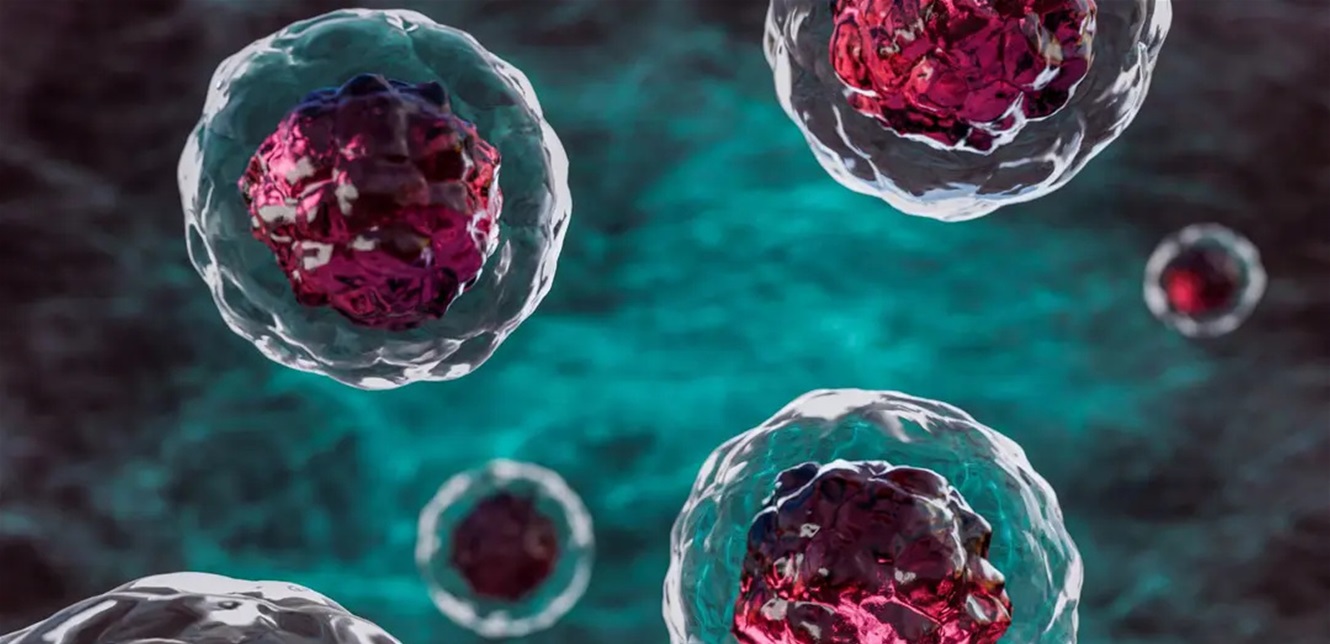
Slovenian research teams have announced an astonishing scientific achievement: their ability to produce three-dimensional microstructures directly inside living human cells. This was accomplished using a laser printing technique known as “two-photon polymerization.” This discovery marks the beginning of a new era in understanding cellular functions, measuring chemical changes occurring within them, and even applying precise mechanical forces inside the cell.
The researchers explained that human cells are very small and filled with organelles and proteins, with a size of about 20 micrometers, which is approximately one-fifth the thickness of a human hair. This small size posed a major challenge for introducing solid structures without affecting the integrity of the cell.
The team relied on using ultra-precise glass needles to inject small droplets of “IP-S” material, a biocompatible and non-toxic polymer after solidification, into human “HeLa” cells. Each droplet was then exposed to an ultrafast laser through a precision microscope, which allowed the material to be deposited at specific points only, thereby building precise three-dimensional structures without damaging the internal components of the cell.
Experiments showed the possibility of printing various shapes inside the cells, such as a small elephant with a size of 10 micrometers, laboratory logos, hollow grid structures, as well as small spherical objects. The images showed that the cell nuclei had changed shape to provide space for the printed structures, while the surviving cells continued to divide and grow normally.
The results revealed that about 55% of the cells containing printed structures were no longer alive after 24 hours, a rate similar to other invasive techniques, such as opening the cell membrane without printing. Studies showed that structures larger than 5 micrometers delay cell division for at least one hour, indicating the subtle effects that intracellular structures have on cell behavior.
The researchers confirm that this technology is still in its early stages and is currently limited to narrow-scale use, but it opens promising horizons for developing intracellular sensors, delivering drugs locally, or studying mechanical forces inside living cells with unprecedented precision.