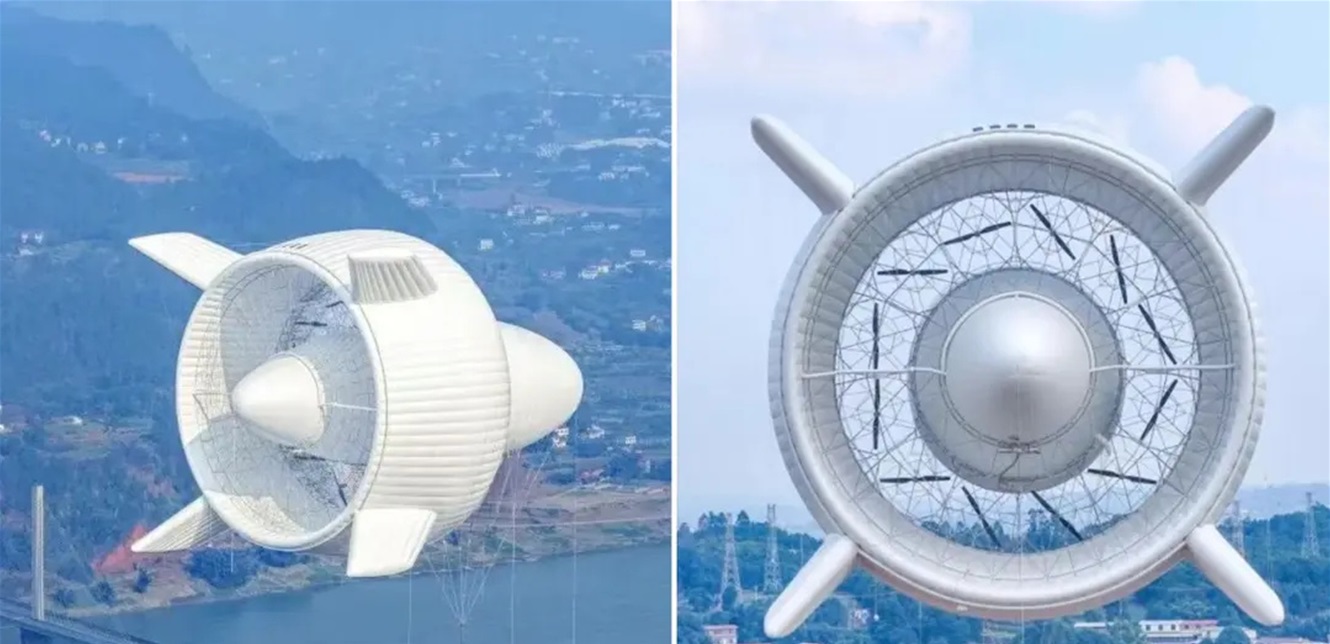
A Chinese energy company has announced the successful first flight and power generation test of its “S2000” megawatt-class Airborne Wind Energy System (AWES), which is considered pre-commercial. The test took place in Sichuan Province in southwestern China.
During the test, which took place on Sunday in the city of Yibin, the aerostat was able to rise to nearly 2,000 meters (6,560 feet). The aerostat successfully generated 385 kWh of electricity, then connected it directly to the local grid. This experiment is the first of its kind to generate power using this system known as “SAWES”.
This system is based on the idea of using a helium-filled aerostat to lift a wind power generation unit to the upper layers of the atmosphere, where the winds are stronger and more consistent compared to wind levels near the earth’s surface. The wind power is then converted into electrical power, which is then transmitted to the ground via a fixed cable. This cable also helps stabilize the aerostat and control its position during operation.
This system is characterized by its design, which relies on ducted air channels that direct wind towards the blades, increasing the efficiency of the generation process. The system consists of 12 turbines within its structure, with a total volume of about 20,000 cubic meters and a rated capacity of 3 MW.
Wang Hanke, the technical director of the developing company, explained that the system aims to achieve two main objectives: The first is to use it in remote areas or those outside the electrical grid, such as border guard posts, to provide a stable power source. The second is to use it to supplement traditional ground-based wind power generation systems, resulting in a three-dimensional power supply.
The company announced the start of limited production of this system, in addition to signing letters of intent with several coastal and elevated cities in China. The company is also building a facility in Zhoushan City, Zhejiang Province, to produce the high-performance materials needed for the aerostat, in order to enhance local self-sufficiency and reduce dependence on imports.
The company confirms that this achievement represents an important step towards the development of clean energy sources in the future, taking into account that this technology is still in its early stages, and that there is a need for further testing and verification of its long-term stability, in addition to ensuring its safety and economic performance.