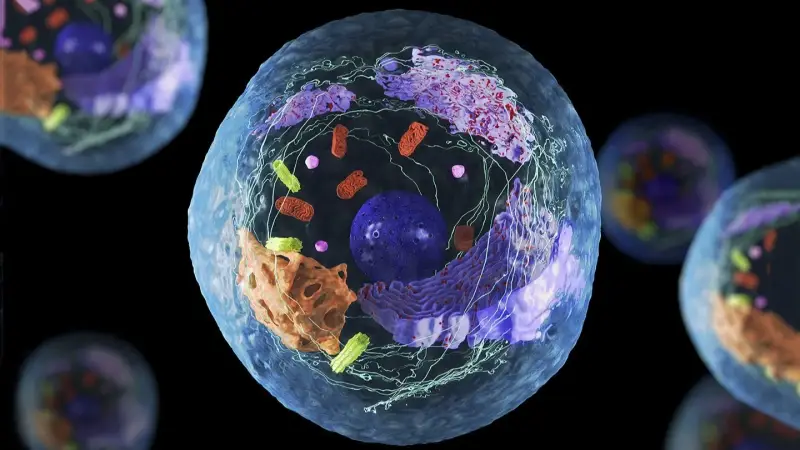
Cells are never in a state of true stillness. Even when it outwardly seems like nothing is happening, they continue to consume energy to keep some chemical reactions active, while preventing others from occurring. This hidden work helps cells maintain their organization and selectivity.
How cells work
A new study indicates that this invisible energy consumption is greater and more organized than scientists previously thought. Researchers have developed a method to estimate the cost of cellular control by dividing it into two parts:
* The energy required to support desired reactions.
* The energy spent to curb unwanted reactions.
This approach redefines metabolism as more than just a series of chemical steps, and shows that cells are constantly forced to pay to maintain order within a noisy molecular environment. This work was led by “Prafull Gaikwad” from the University of Tokyo, introducing a new tool for comparing the energy cost of different metabolic pathways.
The study, published in the journal “Statistical Mechanics: Theory and Experiment”, shows that in the world of cells, which is governed by thermal randomness and molecular fluctuations, simply maintaining constraints requires energy. This cost appears in the form of wasted heat and loss of chemical effort, even if the system appears stable from the outside.
Since the beginnings of life, maintaining chemical differences between the inside and the outside has required energy, forcing early systems to choose specific reactions and curb others. The study suggests a framework that measures the cost of each metabolic pathway, taking into account both the cost of sustainability and the cost of restriction.
By comparing these costs, one can understand why biological developments choose the least costly pathways, leaving a large part of what is chemically possible outside the scope of actual life.