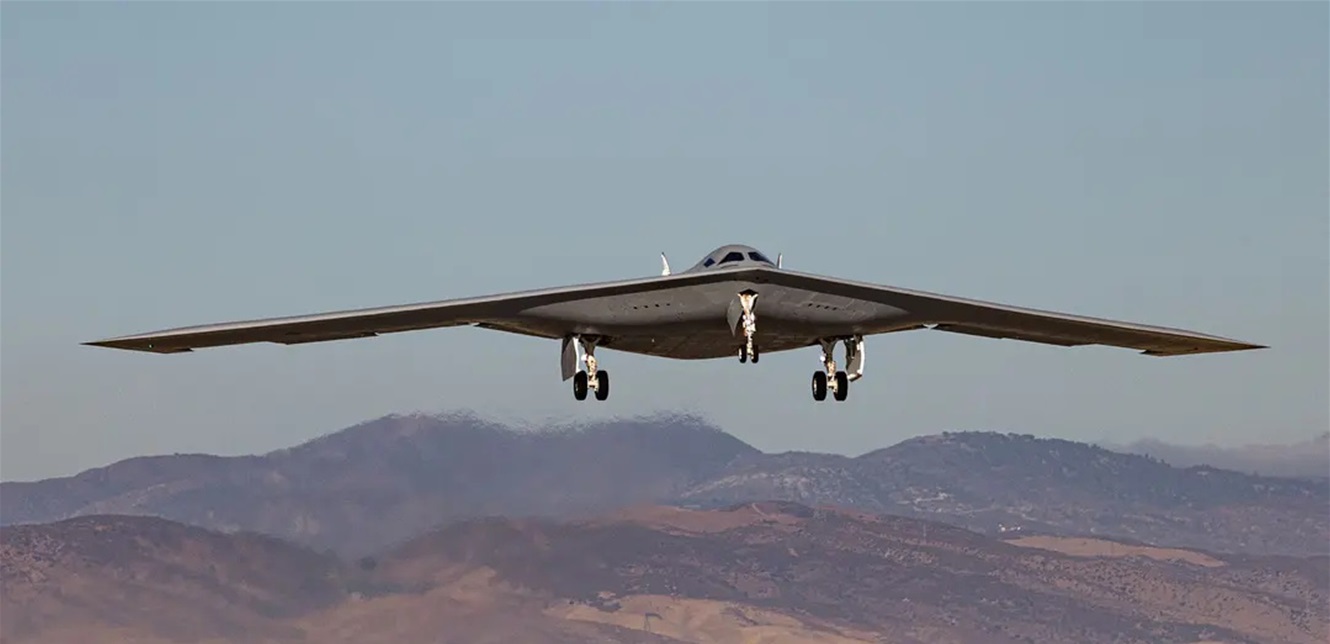
Chinese researchers have announced the development of an “advanced aerodynamic simulation tool” capable of changing the way modern military aircraft are designed. Initial results indicate “potential limitations in aerodynamics and stability” of some publicly released designs for the new US next-generation bomber: the “B-21 Raider.”
According to a study published last month in the journal “Acta Aeronautica et Astronautica Sinica,” the program called “PADJ-X” is a comprehensive design platform that combines multiple engineering disciplines into a single optimization process, significantly reducing the time and computational power typically required to develop advanced aircraft.
“PADJ-X” relies on “Adjoint Optimization” technology, an algorithm that allows thousands of design parameters to be adjusted simultaneously, compared to traditional trial-and-error methods, which often achieve incremental and costly improvements.
The research team, led by “Huang Jiangtao” from the China Aerodynamics Research and Development Center, applied “PADJ-X” to hypothetical designs resembling the American “B-21” bomber, which is still undergoing flight testing. The simulation showed that “aerodynamic improvements raised the lift-to-drag ratio by approximately 15% and significantly improved the aircraft’s stability,” potentially allowing for longer flight range and better fuel efficiency.
The researchers clarified that their results were based on “theoretical models and shapes inferred from public sources,” without access to the confidential data of the “B-21” bomber, whose actual specifications remain secret to the US military.
“PADJ-X” combines five main areas: “aerodynamics, propulsion, electromagnetics, infrared signature, and sonic boom reduction,” allowing engineers to balance conflicting design requirements, such as reducing radar detection while maintaining flight efficiency and structural integrity.
The team also applied the program to a design similar to the American “X-47B” drone, where it contributed to reducing drag by 10% and significantly reducing the forward radar cross-section, from 13.55 square meters to approximately 1.33 square meters.
The researchers noted that adjoint optimization tools are not new, as NASA began developing similar platforms in the 1990s. However, “PADJ-X” allows for the integration of a larger number of disciplines and automatic updating of parameters, which may accelerate aircraft development, reduce reliance on wind tunnel testing, and lower prototype costs, with the potential to improve the range and efficiency of future aircraft, whether manned or unmanned.