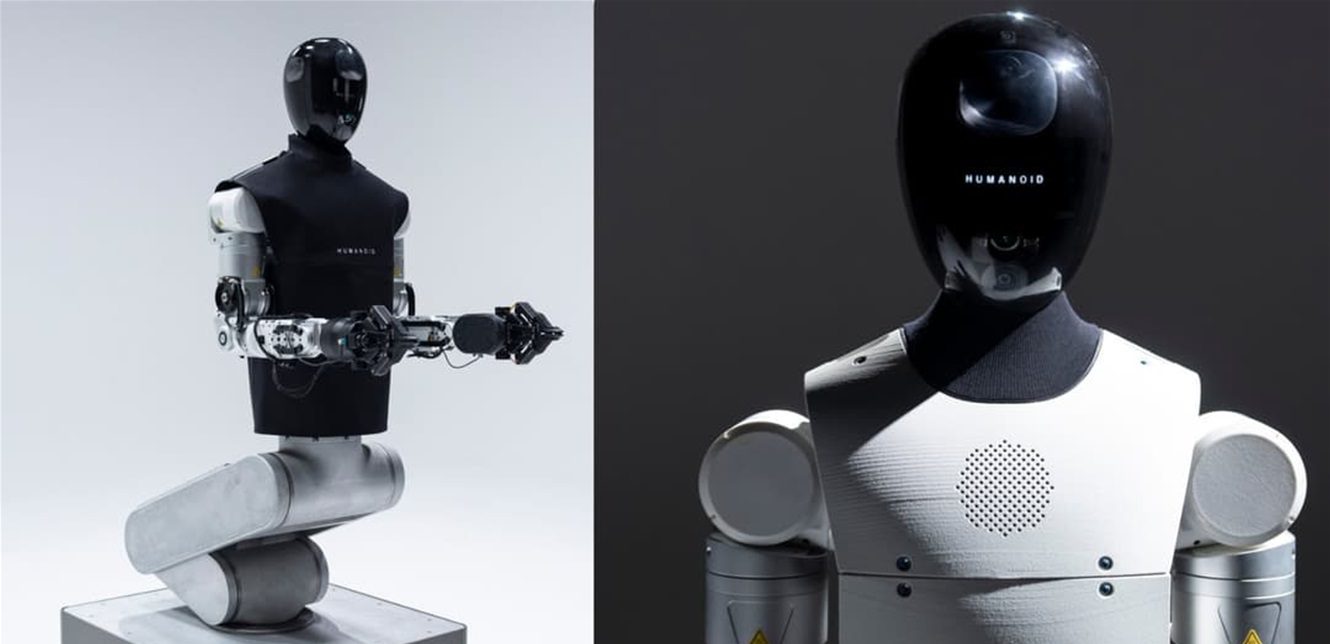
After just seven months of development, “Humanoid” has unveiled its “HMND 01 Alpha” prototype, marking a milestone in the world of humanoid robots. The company describes this period as the shortest in the development of a humanoid robot to date.
The “HMND 01 Alpha” is a mobile humanoid robot that relies on wheels instead of legs. The company has already begun implementing initial commercial trials in collaboration with global companies in the industrial and automotive technology sectors.
Humanoid is currently displaying the robot at its booth at “CES 2026” from January 6 to 9. The robot is being showcased in a near-realistic industrial environment, not in a traditional lab setting.
During the demonstration, the “HMND 01 Alpha” performs a realistic industrial task of picking up metal bearing rings from random and cluttered boxes, completely independently. This represents actual working conditions in factories, not just a simplified demonstration.
The robot is approximately “220 centimeters” tall and moves on a wheeled base at speeds up to “4.47 miles per hour.” The robot can carry up to “15 kilograms (33 pounds)” using its arms, with the ability to lift heavier weights closer to its body.
The robot’s range of motion extends from ground level to a height of two meters, with the ability to reach a depth of “60 centimeters” inside shelves, allowing it to handle materials stored on the ground or at different heights.
The robot has “29 active degrees of freedom” (excluding grippers) and relies on an integrated artificial intelligence system to fully manage movement and perform tasks. The robot can be equipped with either a five-fingered hand with 12 degrees of freedom or a simple parallel gripper, depending on the precision or payload requirements.
The “HMND 01 Alpha” features a head equipped with advanced sensors, including 360-degree RGB cameras and depth sensors, giving it the ability to understand and interact with crowded industrial environments in real time.
During the exhibition, the robot works directly in the booth of “Schaeffler Group”, where it picks up disorganized bearing rings and places them on an intermediate table, which in turn feeds the bearing ball assembly line in real factories.