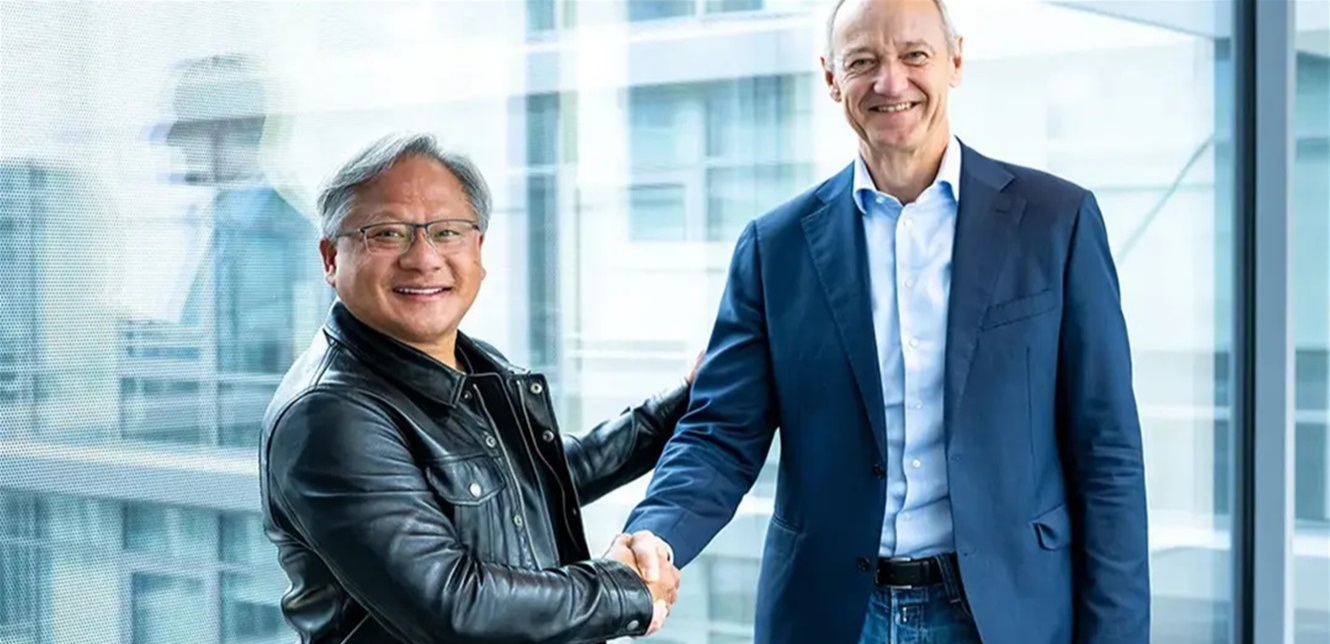
At “CES 2026,” Siemens and Nvidia announced the expansion of their collaboration to develop what they described as an “Industrial AI Operating System.” This platform aims to integrate artificial intelligence into all stages of the industrial cycle, from design and engineering to manufacturing, operations, and supply chains.
The two companies explained that this platform will enable “simulating changes virtually, testing optimizations in real-time, and translating results directly to production lines,” which accelerates the pace of innovation, reduces costs and risks, and shortens the duration of operation.
The first “fully adaptive AI-powered manufacturing site” is expected to launch in 2026, at the “Siemens electronics factory in Erlangen, Germany.”
As part of this expanded partnership, Nvidia will provide the necessary infrastructure for industrial AI, simulation libraries, models, and frameworks, while Siemens will dedicate hundreds of experts in the field of industrial AI, in addition to its software and hardware solutions.
“Roland Busch,” CEO of Siemens, confirmed that this collaboration represents a “transformation in the way physical systems are designed and operated.” He added: “Together, we are building an Industrial AI Operating System, redefining how the physical world is designed, built, and managed, to expand the application of artificial intelligence and achieve a real impact on the ground.”
Self-Adapting Factories
This project is based on the idea of “factories that constantly analyze their digital twins.” Using an “artificial brain” powered by software-defined automation, industrial process software, and “NVIDIA Omniverse” libraries, factories can practically test changes virtually before applying them on the ground.
The two companies explained that this method enables “faster and more reliable decision-making” from the early stages of design to implementation, while enhancing productivity and reducing risks. The scope of these capabilities is set to expand to include various industrial sectors, and companies such as “Foxconn, HD Hyundai, KION Group, and PepsiCo” are currently evaluating this technology.
Accelerating Simulation via Graphics Processing Units
Siemens announced “full acceleration of its tools’ simulation using graphics processing units (GPUs),” with support for “NVIDIA CUDA-X” libraries and AI-based physics models. This allows users to conduct larger and more accurate simulations at a higher speed. The two companies are also working on developing “generative simulation models” using “NVIDIA PhysicsNeMo” to create independent digital twins capable of continuous engineering design and instant optimization.
“Jensen Huang,” founder and CEO of Nvidia, said: “Generative AI and accelerated computing are driving a new industrial revolution, transforming digital twins from passive simulations to active intelligence for the physical world.”
From Chips to Factories
This partnership also extends to “designing the infrastructure for AI and electronic chips.” Siemens will integrate CUDA-X and PhysicsNeMo libraries and GPU acceleration across its electronic design solutions, aiming to achieve “2 to 10 times acceleration in verification, planning, and process optimization.”
The two companies are also working on developing a “repeatable modular blueprint for future smart factories,” to meet high-density computing requirements while considering energy, cooling, and automation, optimizing the lifecycle of AI infrastructure from planning to operation.
Siemens pointed out that “industrial AI is getting closer to workers,” by expanding its portfolio of “AI-powered digital assistants” across design, manufacturing, and operations, and collaborating to bring AI to “Meta Ray-Ban AI glasses” to provide hands-free guidance, safety information, and instant feedback on production lines.
The two companies confirmed that they will first apply these technologies in their internal operations before generalizing them to other industries, with the aim of proving the feasibility of “industrial AI on a large scale.”