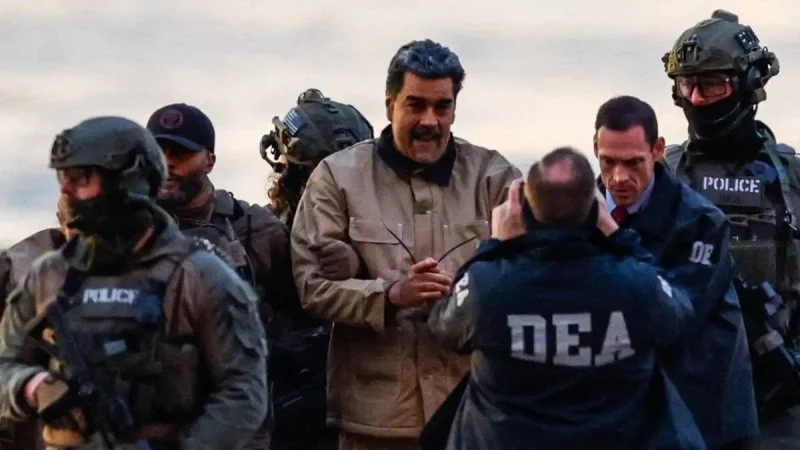
CNN revealed on Tuesday that Senator Marco Rubio is the mastermind behind the strategy that led to the surprise U.S. operation that resulted in the arrest of former Venezuelan President Nicolás Maduro and his wife from Caracas.
The news network reported that Rubio, the son of Cuban immigrants, has made the Maduro issue a top priority for years, and was the “driving force” behind the plan that resulted in the dramatic events Venezuela witnessed that night. Sources confirmed that Rubio harbors a deep personal animosity towards Maduro and has called for severe sanctions against him since President Donald Trump’s first term, describing him as a “drug-linked dictator.”
According to CNN, Rubio’s mandate to lead U.S. efforts in “rebuilding” Venezuela and consolidating American influence there represents a remarkable rise for the head of U.S. diplomacy, and is considered the most dangerous role he has undertaken to date.
A source told the network that Rubio worked closely with Stephen Miller, the White House Deputy Chief of Staff, in the months leading up to the operation to develop the strategy. During that period, Rubio was almost constantly with Trump, spending most of his time inside the White House, taking it as a base to manage the Venezuela file, while he visited the State Department on few occasions for exceptional meetings.
Sources explained that Rubio spent many weekends with Trump in Florida and avoided traveling abroad, preferring to send his deputy instead. Discussions about the Venezuela file also took place in a small circle of the President’s close political advisors, led by Rubio and Miller.
U.S. officials reported that Richard Grenell, who Trump had previously dispatched to Venezuela, did not participate in the development of the strategy, while the post-Maduro phase was planned within Miller’s office in the White House.
According to sources, the approach towards Venezuela brought together Rubio and Miller, known for their hardline positions in foreign policy, where they formed the main pillars of the offensive strategy that led to Maduro’s ouster and arrest. Rubio focused on escalating economic, political, and then military pressure, while Miller was convinced that targeting Maduro as a “drug trafficker running a criminal network” served American interests more than maintaining relations for immigration reasons.
The sources indicated that the two men worked together closely in closed-door sessions, formulating U.S. strategies for dealing with Venezuela, moving seamlessly between negotiation and military decisions, including the bombing of boats suspected of involvement in drug trafficking and strengthening the military presence in the region.
They added that Trump completely trusts Rubio and Miller, and they were able to persuade him to escalate against Maduro, despite the criticism leveled at Rubio by lawmakers who accused him of contradiction, after he had previously denied that the administration was seeking regime change or carrying out strikes inside Venezuela.
Despite the briefings provided by the Trump administration to journalists and members of Congress, the details of the plan remain unclear, while informed sources indicate the marginalization of a large number of federal government officials. A former U.S. diplomat considered the idea of Rubio managing the daily affairs of Venezuela “unrealistic” given his multiple tasks, and suggested he would resort to delegation or the appointment of a special envoy.
There is still no U.S. diplomatic representation inside Venezuela, despite a senior State Department official talking about preparations to reopen the embassy if Trump decides to do so. In this context, Rubio announced that the United States would establish relations with Delcy Rodríguez, who was sworn in as interim president of the country, and pledged to cooperate with the U.S. administration.