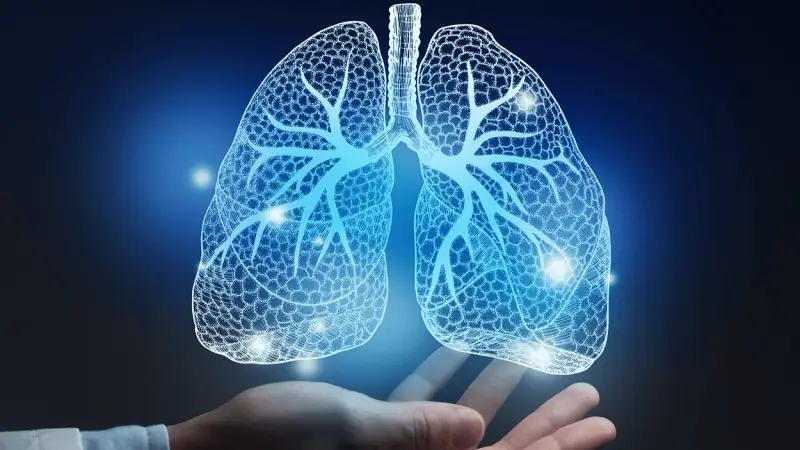
A team of researchers has achieved a significant scientific breakthrough by developing a miniature model of the human lung, using stem cells taken from a single individual. This step is expected to bring about a qualitative leap in the study of respiratory diseases and the finding of personalized treatments for each patient.
The essence of this innovation lies in a simple idea: if we can create a miniature version of a person’s lung in the laboratory, we will be able to test how this lung interacts with different diseases and experiment with drugs on it before giving them to the patient himself.
Scientists have succeeded in converting stem cells into all major types of lung cells, making the new model genetically identical and derived from a single source.
Lead researcher Dr. Max Gutierrez explained that this technology allows for the first time the study of respiratory diseases in a personalized and accurate manner, away from general models or experiments on animals that are biologically different from humans.
The model mimics the microenvironment of the alveoli, the small sacs responsible for gas exchange and protecting the body from microbes.
The cells are arranged on a thin membrane inside a special device that forms a vital barrier similar to natural alveoli. The device allows the simulation of actual breathing movement through three-dimensional expansion and contraction, accurately reflecting the function of the living lung.
To verify the effectiveness of the model, the researchers conducted an experiment to simulate a tuberculosis infection by adding the bacteria that cause the disease. The results were almost identical to what happens in the human lung: a collection of immune cells, inflammatory foci, and then the collapse of the protective barrier of the alveoli after 5 days of infection.
The importance of this achievement lies in its wide applications. Lung models can be created from patients with a genetic predisposition to certain diseases or from special cases, and treatments can be tested on them before they are clinically approved, reducing the need for animal experiments and increasing the accuracy of the results.
Dr. Jackson Luke, a member of the team, confirmed that the model represents a more accurate alternative to animal experiments, avoiding the large biological differences between them and humans.
The researchers aspire to expand the use of the model to study multiple diseases, from viral infections such as influenza and corona, to chronic diseases such as pulmonary fibrosis and asthma, to lung cancer research.
Most importantly, this innovation paves the way for advanced personalized medicine, where treatments are designed according to the individual response of each patient, enhancing their effectiveness and reducing their side effects.