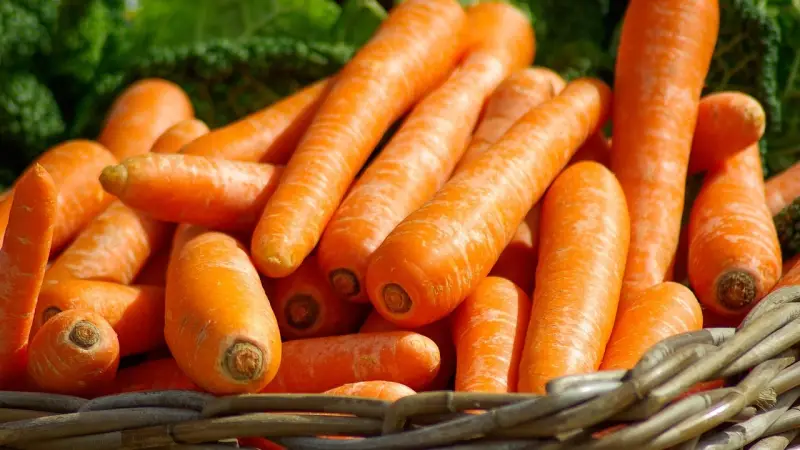
Food factories around the world dispose of huge quantities of vegetable waste daily, while millions suffer from protein deficiency. But a recent scientific study offers an innovative solution to address this dual problem, by converting carrot waste into a rich source of protein.
The study, conducted in Germany, showed that waste from the manufacture of carrot juice or natural pigments retains large amounts of sugars, minerals and nutrients, making it an ideal environment for the growth of edible fungi. Instead of disposing of these by-products, the researchers used them to feed the fungi and encourage them to produce alternative plant protein.
The research team tested 106 fungal strains and found that the fungus “Pleurotus djamor” (pink oyster mushroom) was the most effective, showing rapid and stable growth, as well as high protein production when fed on orange and black carrot waste. After improving growth conditions in terms of acidity and sugar levels, the protein content in the dry biomass reached more than 30%, a percentage similar to some animal and plant protein sources.
It was not limited to laboratory experiments, but this protein was tested in real food products such as veggie burgers and sausages. Taste tests revealed that mushroom-based products outperformed soy or chickpea products in terms of texture and taste, with a more meat-like flavor.
Martin Rühl, a researcher at Justus Liebig University Giessen, confirms that this approach represents a major step towards a circular economy, because it turns neglected food waste into a sustainable source of protein, without the need for agricultural land or additional water.
The study published in the “Journal of Agricultural and Food Chemistry” opens up prospects for a food future that relies on utilizing already available resources, instead of depleting new resources, and proves that today’s waste can be tomorrow’s food.