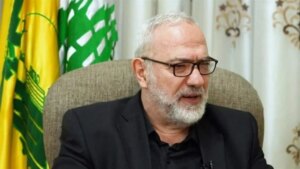
The writer and political analyst, Wajdi Al-Aridi, believes that “the Lebanese aspect of the meeting between Israeli Prime Minister Benjamin Netanyahu and US President Donald Trump in Florida was ambiguous and shrouded in much mystery. In other words, he described Hezbollah as ‘bad’ and did not express his full satisfaction with the issue of the exclusivity of weapons.”
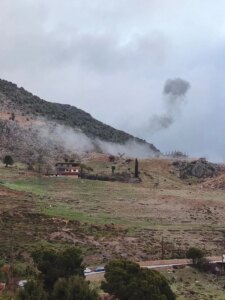
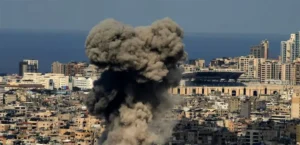
He continued, saying: “But in my opinion, it is consistent with the position of the President of the Republic, General Joseph Aoun, when he said that the specter of war is unlikely, which means that President Aoun has information and data that the United States of America will not allow Israel to launch a wide and comprehensive aggression. To this end, I expect Israel to continue its traditional operations, by striking Hezbollah targets wherever they are located by drones, unless there is a commando operation or a major strike and assassination attempts somewhere.”
Al-Aridi further explained that “the chances of a large-scale war are very slim at this stage, and the information available to me confirms that the Lebanese file is being approached from the angle of the Iranian file, as what concerns Israel and America is Iran, considering that Hezbollah is one of its arms in the region, and perhaps the only arm today. To this end, the eye is focused on Iran, and if a war is launched, it may be on Iran, but the issue of Lebanon is linked to the next two months with how the Lebanese state deals with the issue of the exclusivity of weapons, and after that there may be other talk.”
Regarding the electoral process, Al-Aridi explained that the elections will take place, and that many parties have begun sending envoys to diaspora countries to organize their voting mechanism in their regions and for their parties, stressing that this represents communication with party members and supporters in diaspora countries by the main parties, which makes the expatriates’ voting in their places of residence almost impossible.
He added: “The announcement of candidates by some parties has begun, albeit to a limited extent, pending the coming weeks at the beginning of the new year, when things will be built upon accordingly, and the picture may become clearer if there is a technical extension, but the map of alliances remains the same.”
In Beirut, MP Nabil Badr remains the most prominent and strongest, continuing to perform his role to the fullest extent since the previous elections until today, with sincerity and dedication. Studies are underway to form electoral lists, and we may witness several lists from MP Fouad Makhzoumi and others, and perhaps the change-makers in a new form.
As for the second capital, Tripoli, the situation remains the same, where MP Dr. Ihab Matar has become a landmark with his presence and performance, and his alliances are very clear, far from political feudalism and the symbols of the era of guardianship.
In Bsharri, MP Sheikh William Touk continues his movement quietly, but he has his role, presence, services, and transparency at all levels.
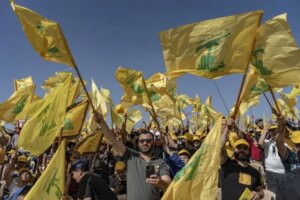
Regarding the alliance between Hezbollah and the Free Patriotic Movement, Al-Aridi stated that the matter is under study, especially in Baabda, where Professor Fadi Bou Rahal is still a potential candidate for the Free Patriotic Movement, as he is a friend of President Michel Aoun and close to MP Gebran Bassil, and communicates with the people of the region from various segments and sects, from the coast to the mountain.
In the Aley and Chouf region, there may be an alliance between the Lebanese Forces and the Progressive Socialist Party, given the mutual desire, but there is no assignment of votes from either party. As for the Christian candidate, the son of the former vice president of the Progressive Socialist Party in the seventies, Professor Samer Khalaf, may be a candidate on the Jumblatt list, and he is the son-in-law of the late Minister and MP Jean Obeid, and has relationships in the mountain throughout its length.
Also, the Arslanian movement has begun to interact in the Aley region, based on the presence of the seventies, through the role, services, and communication with everyone, especially with the sheikhs and others, and this is highlighted by former Minister Saleh Al-Gharib in the Shahhar region, where he enjoys remarkable dynamism, and communication between him and the Progressive Socialist Party continues apace, but the picture has not yet become clear regarding the lists.
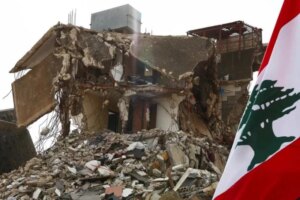
Regarding international conferences, Al-Aridi stated that all donor countries’ conferences, the reconstruction process, and support for the army are still surrounded by ambiguity, pending the next two months, and this is related to the issue of the exclusivity of weapons. But on the other hand, there is a positive interaction and movement by the Council of the South, headed by Engineer Hashem Haider, through communication with the people of the South and providing services at all levels. The surveys and estimates have been completed, and there is a constant movement within the available capabilities, until the political and security picture becomes clear, and then it is built upon to launch the comprehensive reconstruction workshop.
Al-Aridi concluded his speech by saying: “The government is working according to the available capabilities, but there must always be a personality that is considered the “Personality of the Year” to motivate others to play an active role in their ministries, after what we witnessed in the governments after Taif of corruption, abuses, and others. Hence, I considered the Minister of Public Works and Transport, Fayez Ghosn, to be the Personality of the Year at the ministerial level, through the great role he played, and this constitutes a Druze consensus within his incubating environment, and at the national level, from the far south to the far north, as testified by all politicians and Lebanese.”