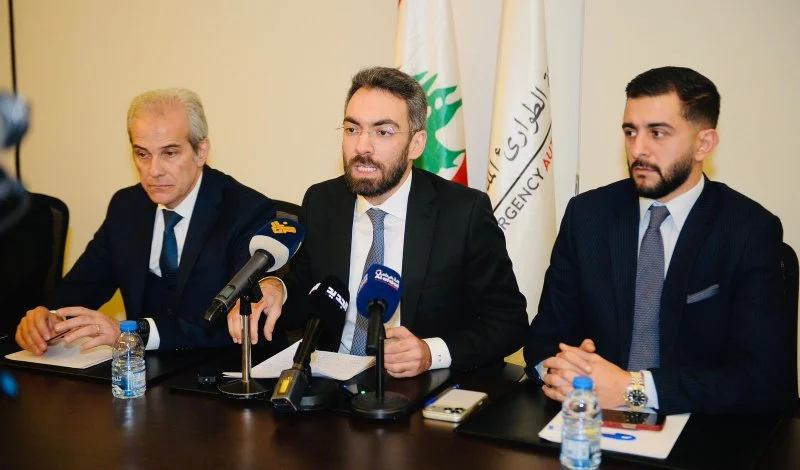
The head of the Civil Emergency Authority in Lebanon, “Elie Saliba,” held a press conference at the authority’s headquarters in Beirut, dedicated to discussing the conditions of prisons and the general amnesty. The conference was attended by the representative of the head of the Beirut Bar Association, “Imad Martinous,” a member of the Bar Council, “Labib Harfoush,” the Vice President of the Lebanese Youth Movement, lawyer “Mohammad Ali Shams,” the Vice President of the Authority, “Ghassan Majed Oueidat,” the head of the Health Committee in the Authority, Dr. “Hussein Al-Hawari,” the head of the Islamic Renaissance Charity Association in Imam Jbeil, Sheikh “Ahmad Ghassan Al-Laqis,” in addition to “Hamed Daher,” representing the Arab tribes.
During the conference, “Saliba” confirmed that the number of deaths in Lebanese prisons during the year 2025 exceeded 37 cases, most of which are due to overcrowding that exceeds 250%, in addition to the lack of medical and health services, despite the great efforts made by the Internal Security Forces to provide appropriate detention conditions for detainees. He announced that there are no cases of tuberculosis or cholera in prisons, but rather an influenza epidemic “H2N3” has affected a number of prisoners.
He stressed that the most important and first solution to this crisis is to issue a general amnesty law that directly excludes the killers of the Lebanese army, those who committed the Beirut port explosion, and crimes of corruption, bribery, and waste of public money, in addition to those prosecuted in personal rights cases. He pointed out that describing the amnesty as an amnesty for Islamists is inaccurate, because their number does not exceed 300 out of 8,000 detainees, including 2,400 Syrians and more than 6,500 unconvicted individuals, considering that Islamists represent a small part of the general amnesty issue, contrary to what some promote, as the amnesty includes various sects and regions.
“Saliba” added that the general amnesty represents a solution to the problem of the new Syrian authorities’ demand to recover the Syrian detainees, due to the lack of another mechanism to recover them, warning that thinking about removing the Syrians from prisons without removing the Lebanese will lead to a revolution inside the prisons and a major crisis that the country cannot bear the consequences of.
He stressed the need for the general amnesty to be accompanied by a real reform of prisons in terms of construction, equipment, and programs that prisoners are subject to, in addition to cleaning the criminal records of those covered by the amnesty to enable them to obtain jobs and work, to avoid their return to committing crimes if their records carry sentences that prevent them from working for three years in misdemeanors and seven years in felonies.
“Saliba” explained that the general amnesty is within the powers of the Parliament, and can be approved by a simple majority through the vote of 33 deputies out of 65 who secure the legal quorum for the session, stressing that the President of the Republic cannot be asked for a general amnesty, but rather the demand must be directed to the Parliament and parliamentary blocs, especially in this period preceding the parliamentary elections.
He believes that until the general amnesty is approved, the judiciary must apply the provisions of Article 108 of the Code of Criminal Procedure and adhere to the maximum period of detention in felonies and misdemeanors, and replace detention in misdemeanors with financial guarantees and travel bans to alleviate overcrowding, and not resort to detention except in serious crimes, calling on judges to apply the provisions of Article 402 of the same law and visit prisons periodically to check on the conditions of prisoners.
“Saliba” announced an initiative launched by the Authority that includes forming a team of doctors to examine and inspect prisoners in prisons and detention places and provide the necessary treatments and medicines at the expense of the Authority, after obtaining the approval of the Attorney General at the Court of Cassation and the Director General of the Internal Security Forces.