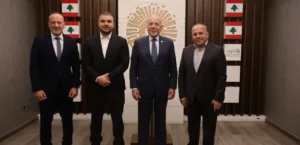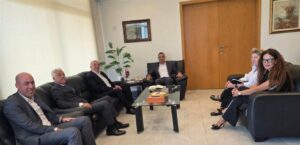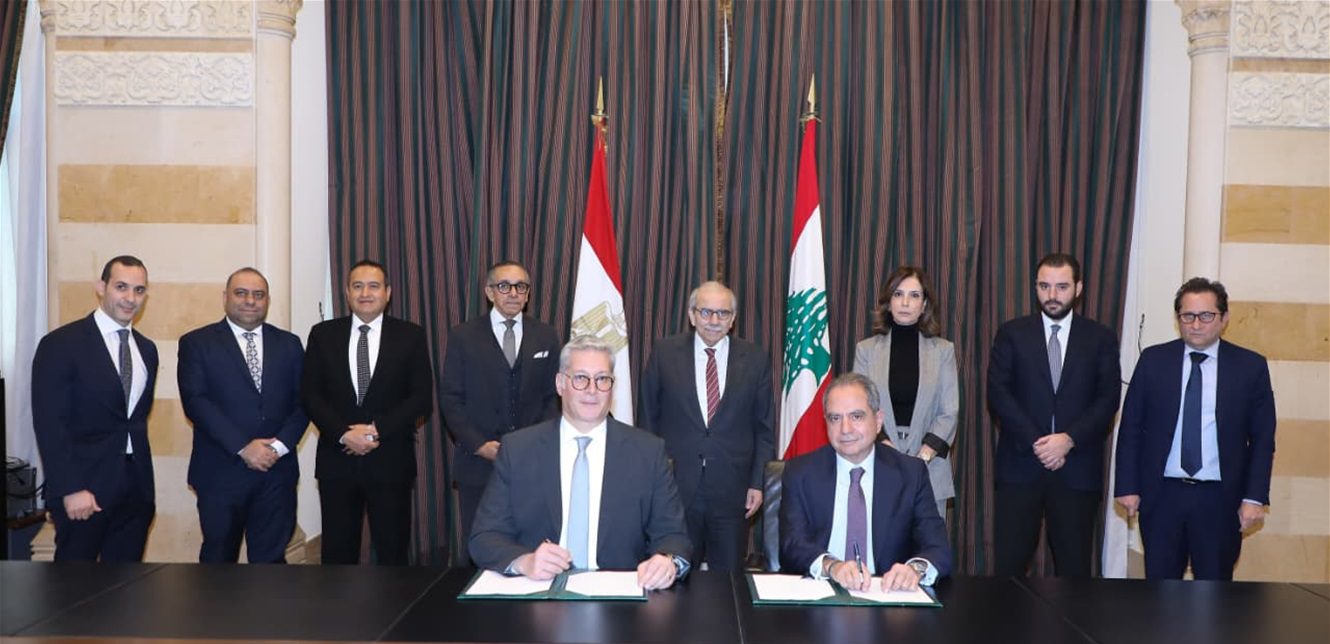
This afternoon, Prime Minister Dr. Najib Mikati sponsored the signing ceremony of a memorandum of understanding between the Arab Republic of Egypt and the Lebanese Republic, aimed at meeting Lebanon’s needs for natural gas used in electricity generation. The Lebanese side was represented by Minister of Energy Joe Sadi, while the Egyptian side was represented by Minister of Petroleum and Mineral Resources, Engineer Karim Badawi. The signing ceremony was attended by the Egyptian Ambassador to Lebanon, Alaa Moussa, the Executive Managing Director of the Egyptian Natural Gas Holding Company “EGAS,” Engineer Mahmoud Abdel Hamid, the Supervisor of the Central Administration of Legal Affairs at the Ministry of Petroleum and Mineral Resources, Professor Mohamed Al-Bajouri, and on the Lebanese side, the Minister’s Advisor, Attorney Boutros Hadchiti, and a member of the Petroleum Sector Authority, Engineer Wissam Al-Dhahabi.
Minister Sadi
After the signing, Minister Sadi stated: “We have decided to gradually move the energy sector from using fuel oil to using natural gas for the following reasons: because natural gas is cheaper and less environmentally harmful than fuel oil, and it keeps us away from all the ‘hassles’ of fuel oil tenders. Today, I want to focus on two things: First, we received a report from a technical committee that came to Lebanon at the initiative of our Jordanian brothers to study the status of the pipeline that comes from Aqaba and reaches Syria, and via a second pipeline that comes from the north and supplies Deir Ammar with gas. We received an assessment of what is required from the Lebanese side to rehabilitate the pipeline from the Lebanese section, its cost, and how long it will take. It turned out that its cost is not high, and the time we need is approximately three to four months.”
Minister Sadi pointed out that the same is underway from the Syrian side, and communication will be made with donor agencies to discuss ways to help finance the rehabilitation of the pipeline in the Lebanese part extending from Deir Ammar to the Syrian border in the north.
He added: “Secondly: We insist, through our use of natural gas, that there be diversification in the sources of natural gas, and as we work with the Gulf countries or through the IFC to establish new gas-powered plants and to establish a regasification plant and supply it with natural gas.
Today, we are signing a memorandum of understanding with the State of Egypt to attract natural gas from Egypt when it is available. Of course, all the details in terms of contracting and price will be worked on in the coming weeks. I would like to mention that Lebanon’s strategy is first to switch to the use of natural gas, and secondly to diversify gas sources by land or sea, and today I thank the State of Egypt for this initiative.”
When asked about the expected benefit from cooperation with Egypt, he replied: “It may later lead to contracting with them to purchase natural gas to supply the Deir Ammar plant in the first stage. This will take time because the pipelines need to be rehabilitated and we must also understand from the Syrian side what they need to repair the pipelines on their side, and thirdly there will be negotiations not only with Egypt but with Jordan and Syria.”
In response to a question about whether this was an initial step, he confirmed: “Yes, it is an initial step.”
He also clarified, in response to another question, that the Caesar Act is no longer in effect, and that the technical and technical report received indicates the need to rehabilitate the pipeline in Lebanese territory, adding that they are waiting for the report from the Syrian side to know what they will decide regarding the rehabilitation of the pipeline on their side.