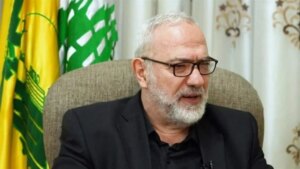
Former Minister Mustafa Bayram affirmed that the concept of martyrdom in Lebanon carries one national meaning regardless of the different positions, considering that the “army martyr” and the “resistance martyr” share a fundamental mission, which is defending sovereignty and protecting the land and the people.
Bayram explained that the main problem is not in the military institution itself, but in a “chronic political decision” that prevents it from fully carrying out its duty, noting that the state’s failure to arm the army does not reflect weakness as much as it shows negligence and a political will to not bear responsibility. In this context, he distinguished between “achieving the goal” and “exerting care,” considering that the authority did neither, which restores the natural and constitutional right of the people as the source of powers and the original owner of the right to defend themselves.
Bayram’s statements came during a tribute ceremony held in the town of Houmin al-Tahta in honor of the three martyrs: “Sergeant Ali Hassan Abdullah,” “Hassan Khodr Issa,” and “Mustafa Muhammad Balout,” in the presence of figures, activists, religious scholars, and a large crowd of townspeople.
Bayram believed that the resistance did not arise as a political option or an alternative to the state, but as a necessity imposed by the enemy and its doctrine based on subjugation and control, stressing that Lebanon was forcibly placed before an existential equation that does not accept neutrality. He pointed out that the resistance was among the first supporters of the establishment of a strong state and a capable army, and welcomed any official decision tasking the military institution with confronting attacks, in مقابل projects seeking to empty the army of its national role and turn it into a functional tool serving the interests of the enemy.
In conclusion, Bayram stressed that the real targeting does not focus on weapons as much as it targets will, identity, and values, calling on the Lebanese state to fully assume its responsibilities, especially in the diplomatic and legal fields, to confront assassinations and violations that clearly violate international laws and charters, stressing that building a strong and capable state is a firm option that does not conflict with the right of defense, but rather depends on it.