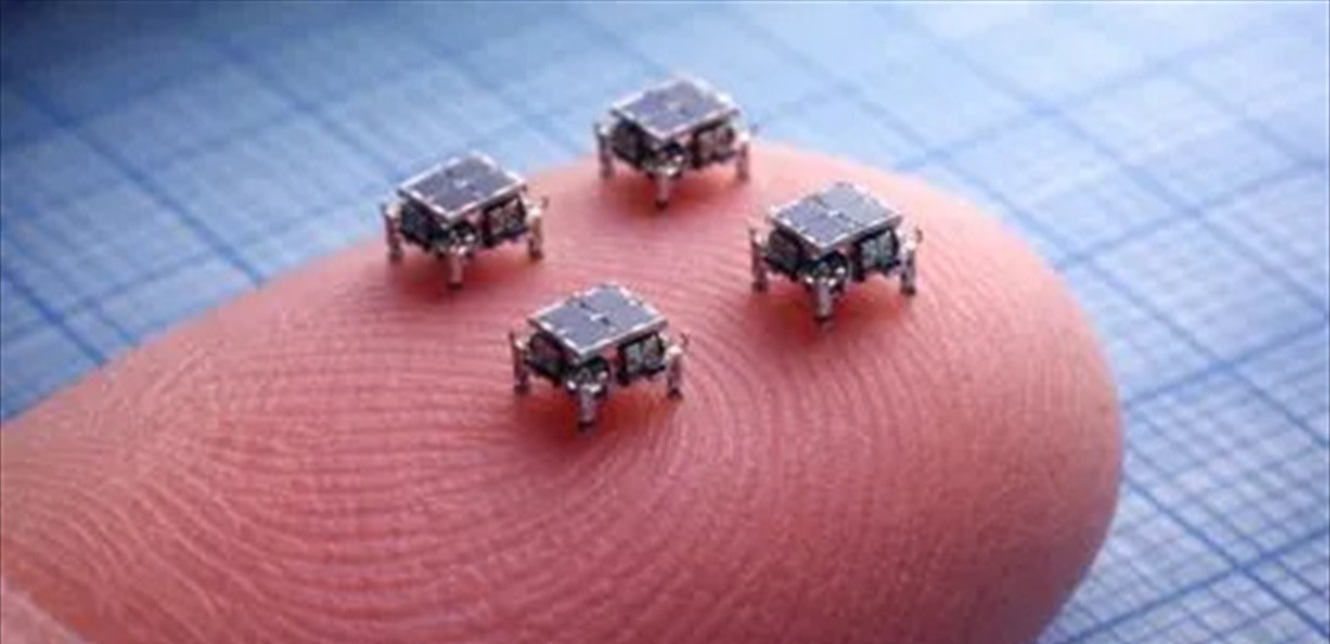
Researchers from the University of Pennsylvania and the University of Michigan have developed an ultra-small robot, no larger than a millimeter, equipped with a microprocessor, motor, and sensors that operate independently.
Although nanomachinery technology is still in the realm of future visions, this invention, which is the size of a grain of salt, is a quantum leap in this field, according to the American newspaper “The Washington Post.”
In this context, Mark Miskin, Assistant Professor of Electrical and Systems Engineering at the University of Pennsylvania and a contributor to the study, stated that this innovation represents the first ultra-small robot capable of sensing, making decisions, and performing tasks.
For his part, research participant David Blau from the University of Michigan explained that the device is still under testing, but he expects that this type of robot could be used more widely within ten years.
How does it work?
The robot is designed as a microelectronic chip and is made of similar materials such as silicon, platinum, and titanium.
The robot is surrounded by a glass layer to protect it and enable it to operate in liquid environments.
It relies on solar cells to power its built-in computer and propulsion system.
The robot moves by swimming, using a pair of electrodes to create a current in the surrounding water molecules.
Its computer is less powerful than modern laptops, but it is able to respond to changes in its environment, such as changes in temperature.
The team stated in the study: “At this level, the robot’s size and energy budget are comparable to many single-celled microorganisms.”
The robot’s ability to communicate with human operators is one of its most prominent features.
Miskin explained: “We can send it messages telling it what we want it to do, and it can send us messages telling us what it saw and what it did.”
According to the American newspaper, the biggest challenge in the future is the possibility of establishing communication between these tiny robots themselves.