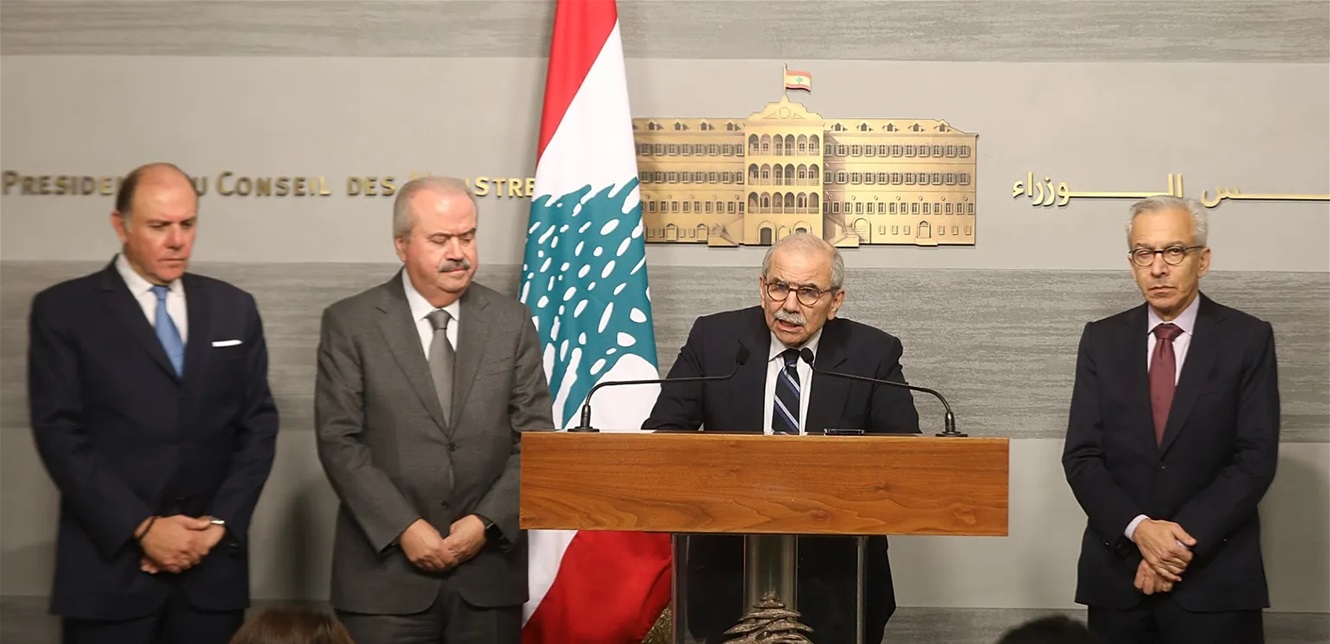
Amid promises of restoring deposits and fears of their dissipation, the issue of the financial gap has returned to the forefront with the government’s commencement of studying the “Draft Law on Financial Regularity and Deposits.”
Numerous questions still linger around this project, given the significant divergence of viewpoints.
While the government sees it as a necessary reformative step in line with reality and the conditions of the International Monetary Fund, considering it a shift from managing the crisis to attempting to legally address it, the Association of Banks has launched a major attack on it, considering it imposes unjustified burdens on banks and threatens their survival.
For its part, the Bar Association sees the financial gap law as a write-off of deposits instead of their recovery, and an implicit exoneration of those responsible from the state and those in power.
As for depositors’ associations, they expressed their discontent, considering that the law does not guarantee the full return of deposits, but is limited to specific percentages, which constitutes an actual dissipation of depositors’ rights.
In this context, the head of the Depositors Association, Hassan Mughnieh, stated in a special interview via “Lebanon24,” “that the financial gap law is “unfair and unjust to depositors,”” noting that the current proposal to distribute $100,000 over four years is a partial solution that does not address the root causes of the crisis.
Mughnieh questioned: “”What about the amounts exceeding $100,000? And even if we talk about recovering them through bonds, these bonds remain of unknown fate, which opens the door to a repeat of the crisis as happened in previous stages.” “
He added: “”There is no clarity in this project regarding the fate of depositors who own deposits or compensations in Lebanese pounds.” “
Mughnieh stressed that “”This law does not constitute a fair or comprehensive solution, but rather entrenches the lack of confidence in the financial system,”” considering that after six years of the crisis “”The government has not provided any clear or transparent explanation about the roots of the crisis and those responsible for it.” “
He also believes that “”The distinction between eligible and ineligible deposits, as adopted by the current government, is unacceptable, as there is no difference between a small, medium, or large depositor, as they are all affected by the same financial policies,”” stressing the need to distinguish between legitimate and illegitimate deposits, because mixing these classifications harms everyone’s rights.
The government faces the most difficult financial test
Yesterday, the draft financial gap law was placed on the Council of Ministers’ table for discussion before referring it to Parliament, with the discussion of the project’s articles to be completed today with additional amendments to some of its provisions, amid political division and international pressure to approve it quickly.
According to “Lebanon24” information, the Council of Ministers discussed in its last session the project’s objectives, general principles, definitions, and scope of application.
The information indicates “”That today’s session may not lead to the final approval of the project, but will be devoted to completing the discussion and amendments, with the emergence of division between supporters who see the law as an entry point to redress depositors and enhance the recovery path, and opponents who consider it a write-off of deposits and the imposition of unfair losses on banks.” “
The street awaits… and depositors on the front lines
Estimates indicate the possibility of depositors moving towards the street with the continued discussion of the financial gap law in its current form.
Depositors’ associations have repeatedly announced that they will continue to escalate and demonstrate in front of Parliament if the law is passed without substantial amendments, considering that it constitutes an actual dissipation of a large part of the deposits.
Following sources via “Lebanon24” report “”That a new campaign will be launched against banks, aimed at educating depositors about the risks of losing confidence in the current banking system, in light of the continuation of policies that depositors describe as unfair.” “
It is worth noting that the financial crisis dates back to 2019, when Lebanon entered an unprecedented financial and economic crisis that led to the freezing of deposits in banks and the collapse of confidence in the financial system, while the size of the financial gap was estimated at about 70 to 80 billion dollars, as a result of accumulated policies of the state, the Central Bank of Lebanon, and commercial banks.