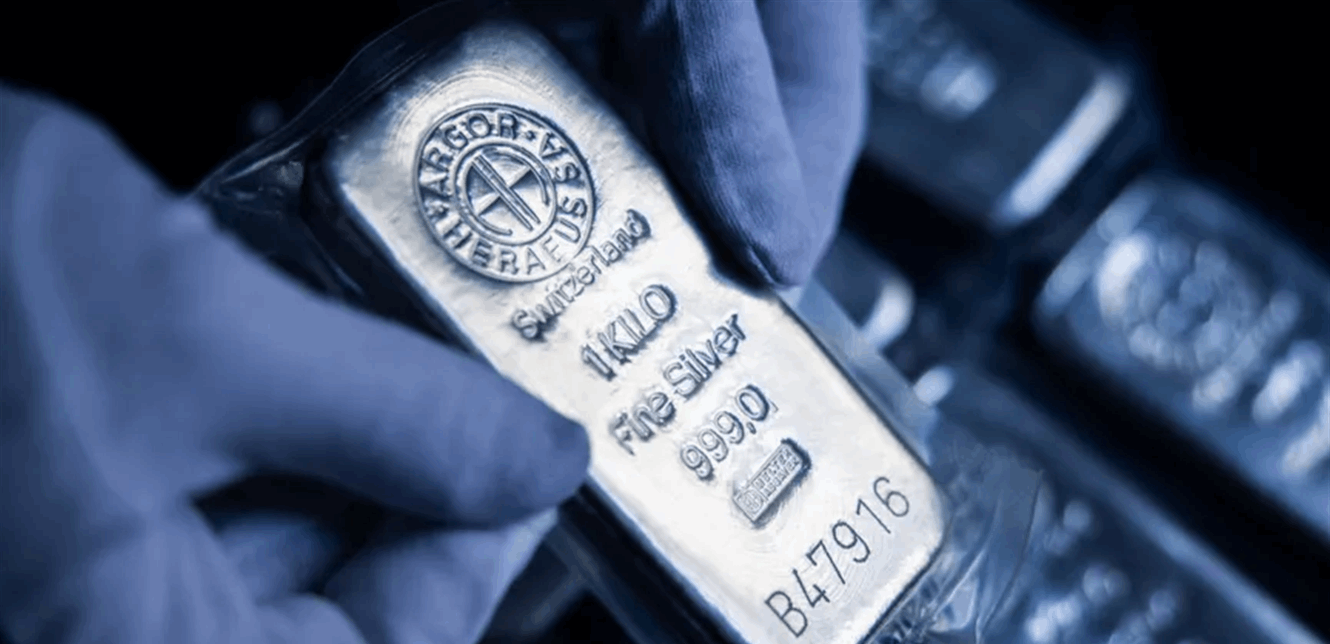
The year 2025 witnessed silver’s unprecedented emergence from the shadow of gold, transforming from the traditional “little brother” to an independent star in the precious metals markets. The price increases were driven by accumulated structural, industrial, monetary, and geopolitical factors, redefining its role in investment portfolios.
These developments open a discussion about the future of silver in 2026 and beyond.
2025 Jump: Why Did Silver Outperform?
This year, silver achieved gains that, in many periods, surpassed gold itself. Its price has risen by about 140% since the beginning of the year to nearly $70 an ounce in today’s trading. This outperformance brought back an old question: Why does silver sometimes rise at a faster rate than gold, even though it is classified as one of the most volatile metals?
The first reason lies in the dual nature of silver. It is not only a safe haven used in times of financial stress and declining confidence in currencies, but it is also a purely industrial metal. More than half of the global demand for silver comes from industrial uses, making it highly sensitive to any expansion in economic activity or technological transformation.
In 2025, this coincided with increasing bets on global interest rate cuts, especially in the United States. These expectations weakened the dollar and raised the attractiveness of non-yielding assets such as gold and silver. However, silver, due to its lower nominal price compared to gold, appeared more attractive to a wider segment of individual and institutional investors looking for higher returns within a larger risk margin.
Trevor Yates, Senior Investment Analyst at Global X ETFs, believes that silver is breaking out towards new historical peaks as markets price in a more positive macroeconomic environment in 2026 and supported by increasing expectations of the Federal Reserve leaning towards a more accommodative policy. He added, “We expect the silver market to continue to be in deficit next year, driven by a recovery in industrial demand and continued strong demand from the solar sector, against limited growth on the supply side,” according to Bloomberg.
The Role of Monetary Policy: Interest and the Dollar
It was not possible to understand the rise of silver in 2025 without looking at global monetary policy. Markets entered the year betting on the beginning of a monetary easing cycle after a long period of tightening, amid slowing growth and rising borrowing costs.
With every signal from central banks suggesting an imminent rate cut, silver responded quickly. Lower real bond yields reduce the opportunity cost of holding precious metals and boost investment demand for them. At the same time, any weakness in the US dollar is directly reflected in silver prices, which are denominated in dollars, adding further momentum to the rise.
Solar Energy: A Silent Rise Engine
One of the most prominent structural factors that supported silver prices this year is the accelerating demand from the solar energy sector. Silver is a key component in the manufacture of photovoltaic cells, and with the global expansion of clean energy projects, industrial consumption has increased at a rate that exceeded expectations.
The energy transition is no longer just a political slogan, but has become a huge investment path supported by governments and major companies. This reality has created long-term demand for silver, different from short-term investment demand, and more stable in its impact on prices.
Supply Shortage: Pressure from Production and Inventories
In contrast to strong demand, the market faced clear restrictions on the supply side. Silver production is often a by-product of extracting other metals such as copper and zinc, which means that increasing supply is not easy or quick to respond to rising prices.
The historical decline in silver inventories on the London Stock Exchange during periods of 2025 exacerbated the pressures, giving clear signals of a shortage of actual supplies. Such indicators usually raise concerns among industrial investors and prompt them to secure their needs in advance, which creates a feedback loop that pushes prices higher.
Warnings: Volatility and Hidden Risks
Despite the strong performance, the market was not without warnings. Silver is known for its sharp fluctuations, and its rapid rise in recent months has raised concerns about potential corrections. Some analysts have warned that part of the rise may be driven by speculative flows, especially from individual investors who are attracted to strong and rapid movements.
Also, any sudden change in the course of monetary policy – such as postponing rate cuts or a return of inflation to rise – may negatively affect prices. Therefore, it was clear that silver in 2025 was a great opportunity, but it was not without risks.
Historical Comparison: Is Silver Approaching Record Peaks?
The rise in prices reopened the discussion about the possibility of silver exceeding its historical peaks recorded in exceptional periods, the most prominent of which was the beginning of the eighties during the Hunt brothers crisis. Despite the completely different context, some analysts saw that the current structural factors – especially industrial demand – give the current rise greater credibility compared to previous historical bubbles.
However, exceeding those peaks remains contingent on a delicate balance between investment and industrial demand, continued pressure on supply, and a supportive monetary environment.
2026 Scenarios: Three Possible Paths
As 2026 approaches, eyes are turning to see if silver is able to maintain its gains or even expand them. Expectations can be summarized in three main scenarios:
The Positive Scenario: An Extended Upward Cycle
In this scenario, central banks actually begin to cut interest rates, the dollar weakens, while the expansion in renewable energy projects continues. If this coincides with a continued supply shortage, silver may witness a new wave of gains, amid expectations that it will record levels not seen in decades.
The Balanced Scenario: Stability with Fluctuations
In this scenario, silver may maintain relatively high levels, but remain in a sideways trading range. Industrial demand will remain supportive, but the absence of strong monetary incentives will limit sharp rises. This scenario is the most likely for many financial institutions, because it reflects a balance between supportive factors and risks.
The Negative Scenario: Painful Correction
If inflation returns to rise or rate cuts are delayed, silver may be subject to corrective pressures, especially if investment flows decline. In this scenario, the losses are greater for investors who entered the market at peak prices, reminding them of the high-risk nature of silver.
Silver in Investment Portfolios: How Do Investors View It?
One of the main lessons from 2025 is that silver is no longer just a traditional hedging tool, but has become a hybrid asset that combines the characteristics of a safe haven and an industrial growth tool. This dual role makes it attractive, but at the same time increases the complexity of its evaluation.
Long-term investors may view silver as a bet on the energy transition and the green economy, while speculators see it as an opportunity to take advantage of sharp fluctuations. Between these two parties, risk management remains a crucial factor.
The rise in silver prices in 2025 was not a passing event, but the result of a deep interaction between monetary policy, industrial transformation, and supply shortages. Although the road to 2026 is full of divergent scenarios, what is certain is that silver has regained its position as one of the most interesting assets in global markets.
The question is no longer whether silver will remain important, but how investors will deal with a metal that combines opportunity and risk in one. In a rapidly changing world, silver may be an accurate mirror of broader transformations in the global economy, from central bank chambers to solar energy fields.