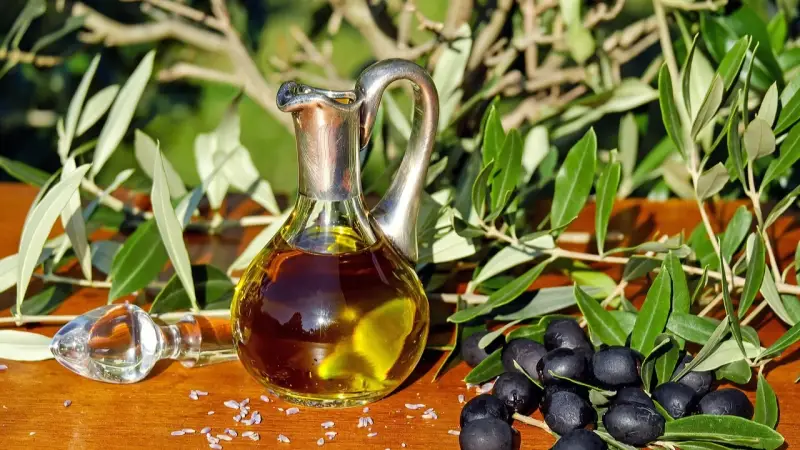
It is known that olive oil offers numerous health benefits, such as containing antioxidants, healthy fats, and anti-inflammatory properties, making it widely desirable. But “What is the percentage of calories in olive oil?” Here is the answer.
Calories in Olive Oil
A “tablespoon” of olive oil contains 119 calories, classifying it as a calorie-dense food.
If the amount is reduced to a teaspoon, the number of calories decreases by about two-thirds, i.e., about 40 calories per serving.
All oils are pure fats, and therefore contain the same amount of calories per tablespoon. For example, corn oil, sesame oil, walnut oil, peanut oil, and canola oil each contain about 120 calories per tablespoon.
Nutritional Facts About Olive Oil
The following nutritional information is provided by the “U.S. Department of Agriculture”:
- Calories in olive oil: 119
- Fat: 14 g
- Sodium: 0.3 mg
- Carbohydrates: 0 g
- Fiber: 0 g
- Sugars: 0 g
- Protein: 0 g
- Vitamin E: 1.9 mg
- Vitamin K: 8.1 micrograms
Thus, the calories in olive oil amount to 119 calories, making it easier for you to include this number in your daily calorie calculator to estimate the percentage of weight gain or loss.
Calories in a Spoon of Olive Oil
A tablespoon of olive oil contains about 119 calories, while a teaspoon contains 40 calories.
Health Benefits of Olive Oil
Olive oil has numerous health benefits.
Most of the fat in it consists of monounsaturated fatty acids. These acids have been shown to increase good cholesterol levels and lower bad cholesterol. Among vegetable cooking oils, olive oil has the highest levels of monounsaturated fatty acids.
In addition to the anti-inflammatory and antioxidant compounds found in it, it may reduce plaque buildup in arteries. It may also help protect the body from harmful chemicals associated with chronic diseases, such as cancer, autoimmune diseases, and heart disease.
It has also been shown to lower fat and blood pressure, all of which are extremely beneficial for the heart.
A “study” conducted in 2017, showed that the polyphenols found in extra virgin olive oil, can help protect against:
- Atherosclerosis.
- Stroke.
- Cardiovascular diseases.
This is followed by oleic acid, the main fatty acid in olive oil. It makes up about 73% of the oil itself, and is also good for the heart.
Extra virgin olive oil also provides the compound oleuropein, which is known for its ability to lower blood pressure. Its intake has been shown to protect low-density lipoprotein (also known as LDL or “bad cholesterol”) from oxidation.
These are the health benefits of olive oil, as it is one of the oils that has health benefits for the body.
Ways to Use Olive Oil in Food
Here are some “ideas” for adding olive oil to your daily diet to benefit from its advantages:
- Use it as a salad dressing: Mix olive oil with balsamic vinegar and mustard to make a simple and delicious salad dressing.
- Drizzle it over roasted vegetables: Toss your favorite vegetables with a little olive oil and roast them in the oven for a healthy side dish.
- Use it in cooking: Olive oil can be used for cooking. More refined types of olive oil can be heated to a higher temperature than extra virgin olive oil, although extra virgin olive oil can be used at lower cooking temperatures. To maintain the flavor and quality of olive oil, use high-quality extra virgin olive oil as a finishing oil.