Our country is full of prominent historical milestones, etched in memory with days, months, years, and decades. These milestones barely appear before they explode, causing shrapnel that affects supporters, opponents, and those accused of treason. If history – as is known – teaches man lessons and makes him more aware and capable of making sound decisions, then our Lebanese history is a rich mine of crucial milestones that, due to the many disputes over them and the scarcity of agreement about them, make us ask a thousand questions about the fate of the homeland described, in the language of peace, as “the message.” Forty-two years have passed since the “May 17” agreement, which was accused of treason. It was preceded by the armistice agreement, and followed by Resolution 1701 to stop the fighting between Israel and Hezbollah, Resolution 425, and the agreement of November 27, 2024 to cease fire between Hezbollah and Israel, leading to what is being echoed today in analyses and reality under the name: “Negotiations of the ‘Mechanism’ Committee to cease fire between Israel and Hezbollah.” And in all these milestones, there is a lot of shrapnel that hits here and there. The developments of this moment’s “mechanism” remind those who have forgotten the “May 17” agreement that was canceled decades ago, which returns today to appear in comparisons between what was done and canceled, and what may be done and threatens – any progress in it – with cancellation. More than forty years, and the world has changed and is changing, but we are still spinning in the same circle. So what are the new details that remind us of an old milestone?
– Nawal Nasr
Negotiations in and around Lebanon are characterized by stagnation, and by many analyses, if not fabrications, exchanged by the parties. More than forty years ago, it was said that the “May 17” agreement was canceled because it was in favor of the enemy and not in favor of Lebanon and the Lebanese. “It is a negotiation managed – as it was said – by Israel on behalf of Lebanon.” The Lebanese President at the time, Amin Gemayel, is the one who canceled its effects. And today, the current Lebanese President, Joseph Aoun, is trying to engineer a necessary agreement at this moment. But the same voices – almost the same ones – have returned to rise in objection from parties that were the direct cause of its formation. So will history rewrite the same scenario? And are the details surrounding today the same as those that existed then?
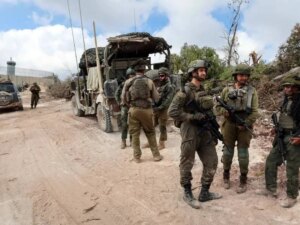
Nassib Hoteit, who once served as a member of the Executive Board of the “Amal” Movement, seems disgruntled by what is happening today, warning of dire consequences if what was canceled in the past is agreed upon today. Hoteit is characterized by his patience and ability to answer any question clearly and frankly. Let’s listen to his point of view: “That May 17 agreement was when Israel was occupying the capital Beirut and imposing its conditions, and the negotiations took place in Khalde. Today, Israel has reached Naqoura, and the negotiations of the ‘Mechanism’ Committee are taking place under its command and according to its conditions. And the spirit of the two agreements – the first agreement and the course of the second agreement if it is achieved – confirms the necessity of achieving Israeli interests, not Lebanese interests.”
But aren’t the surrounding circumstances completely different between yesterday and today? He answers: “Today, if the agreement is achieved, it will be more dangerous because it stipulates the establishment of a Trump economic zone, meaning the area is free of its residents, while in the 1982 invasion, the May 17 agreement did not stipulate the displacement of the area. Therefore, the new – expected – agreement is intended to become the judge and ruler between Lebanon and Israel. And what the Israeli enemy has stated and what has been leaked is that the consultations between the two sides are economic and technical. Perhaps the addition of Ambassador Simon Karam’s name to the “Mechanism” Committee aims to establish a sustainable civil dialogue. This is what puts us in front of a dangerous turning point. And what scares us today is that the popular movements that took place in 1982 and led to the cancellation of the agreement, are almost absent on the political and popular levels today. And it does not correspond to the seriousness of what is happening.”
Nassib Hoteit speaks repeatedly using the phrase “Shiites in Lebanon”: “The Shiites today have no choice but to object. The resistance is “working” on the factor of time. We are betting on time. It is in our interest. And it is never in the interest of Israel and the United States of America and the “agents” of the interior. These do not have the luxury of time. And if they had the ability to decide, they would have done so. We have no options but confrontation, but they will collide with internal opposition and…”. We ask him: What luxury are you talking about? And do we, who are sitting in the earthquake-prone area, have this luxury? He answers repeatedly: “The Shiites today are rallying more than ever around the resistance and they are watching what is happening because Israel has not left them any other choice. They were not given any other opportunity. The West, for the most part, does not know the Shiite logic and Shiite culture. In war, when one party besieges another, it leaves it an outlet to escape. The Shiites in Lebanon have not been left any option to escape. They closed all the outlets on them and said to them we will kill you whether you surrender your weapons or not.”
There may be a point of view in some of what Hoteit said, but he ignored that “Hezbollah” is the one who made the Shiite environment slip into this maze, and that there is a point of view among Shiite objectors that was not heeded by those who brought the sect and the country to a situation from which there is no way out except by surrendering weapons. From war to war to war, the sect and the country have been taken, and negotiations are always in favor of the victor, not the defeated.
In any case, let’s go back to the “May 17” agreement, which is still subject to interpretation today. It is said that it fell due to popular objection. But, when listening to Elie Salem, who was the Minister of Foreign Affairs in the government that signed it, a completely different point of view appears. Salem says: “The May 17 agreement was the greatest diplomatic achievement in the history of the Arab-Israeli conflict. Assad’s Syria made an agreement with Israel to retreat twenty meters. As for the May 17 agreement, there are those who said that Amin Gemayel backed down from it and did not sign it, while, in fact, Israel is the one who backed down from it. We agreed on it and it was signed by the Israeli side, but when they sent the letter to Philip Habib, they included in it that the agreement would not be implemented unless Syria and the Syrian army and all armed Palestinians left Lebanon, and all Israeli prisoners were released by the Arabs. We said to them, we have nothing to do with all of this. We said to them we are not negotiating about Syria but about Lebanon. Based on that, I wrote to Philip Habib saying: The agreement between us is suspended and we consider it as if it never was. They canceled it and I confirmed this cancellation. So would Amin Gemayel sign on a coffin?”.
It is not the popular movement “alone” that canceled that agreement, but Israel. But there are those who continued to promote that it was an agreement of submission and that Lebanon is the one who canceled it alone and boasts. And today, there are those who mention the ability of “popular demonstrations” to repeat what happened. Okay. But the following question: Did Joseph Aoun rush to add Ambassador Simon Karam to the “Mechanism” Committee with a purely personal decision? He consulted with Presidents Nabih Berri and Nawaf Salam. Didn’t he say this? In form, it seems as if he is the one who decided, acted, and implemented alone the appointment of a civilian to the Mechanism Committee, and Sheikh Naim Qassem appeared to say that the participation of a civilian figure in the Mechanism Committee is “an additional fall for the Lebanese government and a free concession to Israel” warning “that its misery will be more severe.” But isn’t Professor Nabih Berri the “big brother” of the resistance and the President consulted with him? Didn’t the political assistant to the Speaker of Parliament, Ali Hassan Khalil, talk about “the necessities of regimes and the choices of peoples” and the difficulty of stopping the train of negotiations that has started? Nassib Hoteit answers: “Even if Khalil stated what was understood as accepting the fait accompli, this is a statement that does not represent anyone but him. And any Shiite figure who declares a speech that is understood to have in its spirit acceptance and understanding, this does not represent anyone but him. As for President Berri, he said: I did not name Simon Karam and I did not agree to what is happening. This is evidence that the Lebanese position is not solid. And it was broken today by the position of the Speaker of Parliament, which weakens the decision of the President of the Republic and Lebanon, which is negotiating “naked””.
Perhaps, but whoever saw those “deep smiles” between Aoun and Berri at the Divine Liturgy on the Beirut waterfront, one day before Baabda announced the decision, is not convinced by Hoteit’s words. He answers: “The relations in Lebanon always have what is apparent and what is hidden. In any case, Joseph Aoun said “in consultation” with Berri and Salam, and it was supposed to be issued a statement from the two men specifying their positive or negative response to the consultation”. If it is true that Berri did not accept the name of Simon Karam during the consultation, but he did not deny his acceptance of the civil negotiations? Hoteit repeats: “There is a vacuum area that needs clarification from President Berri himself.”
We remember here that saying in which: It is fortunate for rulers that people do not think.
Let’s continue. It seems that the solutions – at least outwardly – will remain closed. The resistance is “working” on time while the people in the country are almost breathing their last breaths with the passage of time. So who will convince us this time that the bet of the “Islamic Resistance” will be right as long as all the previous bets in 66 days have fallen? Neither Hoteit nor anyone else from the environment of the “Shiite duo” denies that the “Islamic Resistance,” because it has nothing to lose, will work to harm others if they dare to escalate. It is true that the surrounding circumstances have changed. Syria is no longer as it was on the day the May 17 agreement was canceled. And the circumstances are not easy. But surrender is forbidden and the “Resistance” has not zeroed its capabilities. And the problem is not with “Hezbollah” but with the idea of Greater Israel.
“Hezbollah” will try and will continue to try to find excuses to say that the target is not it but all of Lebanon, with its Christians and Muslims, and therefore it will continue “with those who remain.”
One last question: If it is true that the circumstances surrounding the negotiations of the “Mechanism” Committee contain concessions that the “Shiites” do not accept, then why did His Excellency the President of the Republic, General Joseph Aoun, accept them? Hoteit answers: “He was afraid of American-Israeli intimidation. And the Pope (His Holiness the Pope) came and his visit, contrary to what some saw, is not pastoral but political and…”.
It seems that doubting His Holiness’ visit has begun.
And the solution? There, in the environment of the “Shiite duo,” there are those who say that they are “afraid” not of Israel, which does not have the ability to decide, but of “internal strife.”
It seems that things are going not in the direction of “peace” but towards slipping into mazes: Fighting until the last breath… and against me and my enemies, O Lord.