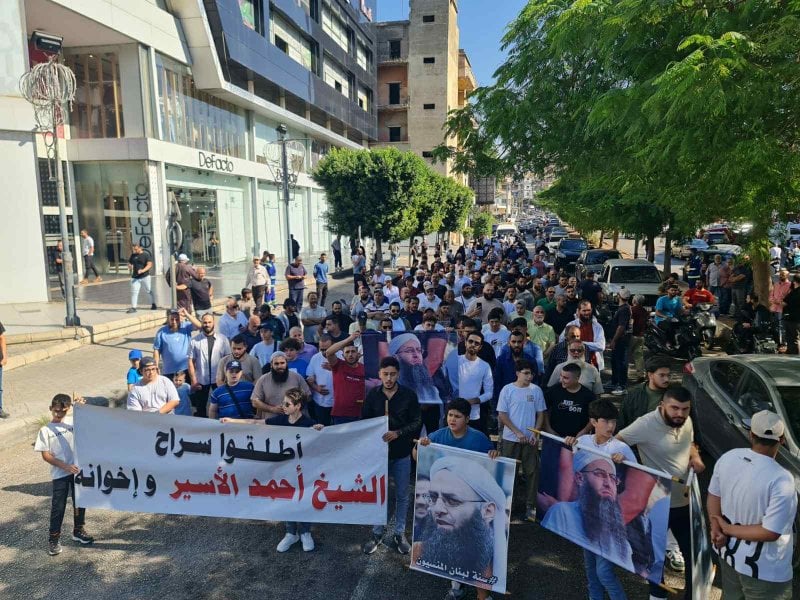
Families of prisoners gathered in various regions of Lebanon following Friday prayers, expressing their anger and discontent with the deteriorating conditions inside prisons, and demanding the issuance of a comprehensive general amnesty to end their suffering and the suffering of their relatives.
Young men from the Bilal Bin Rabah Mosque and families of Abra detainees, in addition to a number of worshippers and supporters, gathered in front of the Aisha Mosque in Sidon, as part of a series of sit-ins that swept across various Lebanese regions, in response to a call launched by the families of prisoners to demand a comprehensive general amnesty.
In a related context, Khaled Al-Boubou, an activist in the Abra file, stated to : “The movement today was peaceful and comprehensive for all of Lebanon, and not limited to a specific group, but included all groups: Shiites, Sunnis, and Christians, for the sake of prisons and their conditions, and demanding a comprehensive general amnesty, to alleviate injustice from thousands of families, and end the suffering of prisoners in conditions that do not befit human dignity.”
Al-Boubou also explained that “The promises regarding addressing the problem of prison overcrowding and other problems suffered by prisoners have not yet been implemented, and things remain the same. As we know, there are final judgments in the Abra file that included young people and sheikhs, some of which are life imprisonment and some are execution, in the era of Iranian guardianship over the country. Therefore, these matters cannot be resolved by talking about justice or speeding up trials, because these people have already been tried, and the only solution lies in a ministerial session discussing this issue or issuing a general amnesty law, which is our main demand today.”
Al-Boubou confirmed that “The movements will continue in the coming period, and this file will not stop as long as there is injustice and the conditions in prisons remain as they are. The demand for a comprehensive general amnesty has become a demand for the majority of Lebanese people in all regions, after exhausting all patchwork solutions.”