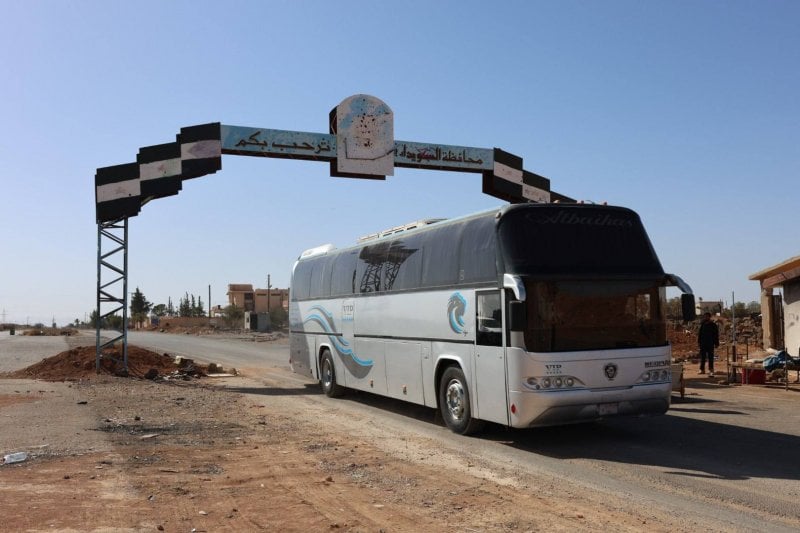
Since the violent clashes that erupted last July, which resulted in the death of more than two thousand people, the governorate of Sweida, with its Druze majority, has not regained its normal life. Residents are afraid to leave their areas and take the road leading to the capital.
In a hospital in the city of Sweida, Lamis (32 years old), who preferred not to mention her full name, says: “We went to Damascus, my brother, my two daughters, and I, to obtain passports for the purpose of traveling. On the way back, I saw a gunman on a motorcycle, who stopped in front of the bus door and asked the driver about our destination. The driver replied: To Sweida. Then the gunman pointed with his hand and started shooting at us from every direction.”
Lamis adds: “My daughter was seriously injured in her hand, and I was also injured. The bus continued to move while bullets were raining down on us. We kept bleeding all the way, the bus was full of blood, there were dead and wounded people screaming… the whole road was just screaming, death, and blood.”
According to the Syrian official news agency (SANA), two people were killed in the shooting that targeted a bus carrying civilians on the Sweida road on Tuesday, and the attack was attributed to “unknown gunmen.”
For its part, the local news platform “Sweida 24” reported that the two victims are: Aya Salam and Kamal Abdel Baqi. It pointed out that the bus was attacked while returning from Damascus in an area within the scope of the Public Security checkpoints, and also mentioned that six people were injured, including two children.
Lamis says: “I feel very scared now of taking this road again. What happened to us was very difficult… We will not be able to pass through it after today, it has become known as the road of death.”
The Sweida governorate witnessed clashes on July 13th between armed men from the Druze community and others from the Bedouin community, which developed into bloody confrontations after the intervention of government forces and armed men from the tribes. While Damascus confirmed that its forces intervened to stop the clashes, eyewitnesses, Druze factions, and the Syrian Observatory for Human Rights accused it of fighting alongside the Bedouins and committing violations against the Druze.
According to the Syrian Observatory for Human Rights, the victims of those clashes included 789 Druze civilians “who were summarily executed by members of the Ministries of Defense and Interior.”
Despite the announcement of a ceasefire, the governorate is still experiencing a state of security tension, as the city of Sweida remained under the control of Druze fighters, while government forces control the surrounding areas.
Last September, Damascus announced a roadmap for reconciliation with the support of the United States and Jordan, based on holding accountable everyone involved in attacking civilians. The Syrian authorities also appointed a local Druze leader as commander of internal security in Sweida.
According to the Syrian Observatory for Human Rights, the past months have witnessed several incidents on the road between Damascus and Sweida, including kidnappings and shootings at civilian cars. The latest incident on Tuesday was the most dangerous, indicating the presence of checkpoints for armed men linked to the authorities but not officially affiliated with the security forces.
Residents of Sweida say they still live in constant fear of the tense security situation despite the cessation of large-scale battles.
Mudar (25 years old), a university student in Latakia, stated: “Yesterday’s story was one of the worst stories that happened recently… I no longer think about going to Sweida until the end of the academic year.”
He added: “This particularly affects students, and it has a great and very difficult psychological impact. A person feels like a stranger in his own country.”
In the same governorate, Safwan Obeid (40 years old) fears missing his appointment at an embassy in Beirut to obtain a travel visa, saying: “The road to Damascus is no longer safe at all, with buses being targeted on the Damascus-Sweida road. The road is not secured, and there is no way to guarantee my arrival to the capital and from there to Beirut.”