Youssef Diab – Asharq Al-Awsat
Lebanese prisoners are living in a state of escalating unrest, threatening a major explosion inside prisons, due to the state’s neglect of their suffering, compared to the accelerated steps aimed at resolving the crisis of Syrian prisoners through a new judicial agreement with Damascus that is being prepared. The prisoners threatened to “respond with escalating steps that will turn the tables on everyone.”
The meetings held by the Lebanese-Syrian judicial committees to coordinate the mechanism for handing over Syrian prisoners to their country have raised the level of anger among Lebanese detainees, who consider that the authorities are practicing “blatant discrimination” against their sons, as they show concern for addressing the conditions of foreign detainees, while leaving Lebanese prisoners to face an uncertain fate inside dilapidated prisons that suffer from an almost complete absence of healthcare, food, and humane conditions.
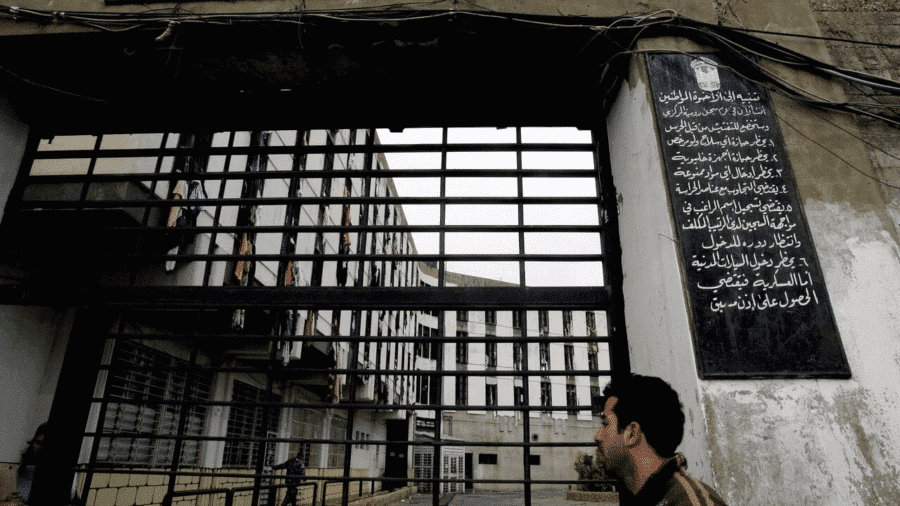
Roumieh Central Prison, the largest prison in Lebanon, houses more than 4,000 prisoners and detainees, three times its capacity, as this prison, which was built in the early 1960s, can accommodate only 1,500 prisoners. The prison witnesses occasional disturbances and protest movements by prisoners.
Final warning message
The competent authorities in Lebanon, specifically the Ministries of Justice and Interior, received a “final warning message” from the Lebanese prisoners, of which “Asharq Al-Awsat” obtained a copy, in which they considered that “seeking solutions from officials is no longer useful.”
The message stated, “The authority in Lebanon is strong against the weak and colluding with the strong, and we have previously warned against any partial solution to the prison file that is limited to Syrian prisoners only, and we said that we have formed a network of prisoners in various Lebanese prisons, and we have prepared ourselves for an escalation that will turn the tables on everyone… After losing our dignity as human beings, we have nothing left to lose.”
In a clear indication of the anger over the progress in the process of releasing Syrian prisoners, the prisoners warned the government against “committing a serious mistake if it proceeds with handing over Syrian prisoners only without finding a comprehensive solution.” They announced that “the escalating steps have been carefully studied, and all plans for action are ready, so the prisons are preparing for a catastrophic scenario and a comprehensive explosion may occur, because any ill-considered step that ignores us and perpetuates injustice against us will push us to turn the tables on everyone, as our despair and frustration have reached their peak, and we no longer have anything to fear.”
The prisoners concluded their message: “We say to the Lebanese state, with its presidencies, parties, spiritual authorities, judges, and media: We have become foreigners in our own country, continue to ignore us and do not take us seriously, and we will burn the prisons as you burned our future, wait for the big explosion.”
Multiple demands
The strongly worded message reached the competent authorities in the Lebanese government. Sources concerned with the prison file confirm that the prisoners have a list of demands, most notably a general amnesty law. The sources told “Asharq Al-Awsat” that the prison file “needs a radical solution that balances justice and the human reality of the prisoner.”
They pointed out that the prisoners’ demands are multiple, and they “begin with a general amnesty law, and setting the years of punishment for death and life sentences, reducing the prison year to 6 months instead of 9, and releasing everyone who has been detained for more than 10 years and has not been sentenced, in addition to merging sentences.”
Message to Jumblatt
The Information Commission of the “Progressive Socialist Party” announced in a statement on Friday that “the former party leader, Walid Jumblatt, received a message from the Lebanese Prisoners Gathering, conveying to him the tragedy of prisons in Lebanon, and calling on him, based on his constant bias towards the oppressed and his support for just causes, to support the measures they demand, including: setting the years for life and death sentences, reducing the prison year to six months for once, releasing every detainee who has been detained for 10 years without trial, and approving the mandatory support of sentences for all files.”
The Commission quoted the Gathering as saying, “Believing in the role of Walid Jumblatt in correcting the state’s compass in the event of any deviation,” and renewed its call to “the Lebanese Ministry of Justice and all concerned parties to expedite the lifting of injustice from hundreds of Lebanese and non-Lebanese prisoners who have spent many years in prisons without trial, and some of them were arrested for purely political reasons,” stressing that “this file is humanitarian, in the first place, which requires distancing it from political tensions and factionalism.”
It pointed out that “the release of Syrian detainees is an entry point for turning the page on the painful past, and a beginning for demarcating and controlling the land and sea borders with Syria, in preparation for establishing normal relations between Beirut and Damascus.”
Parents’ anger
The state of anger and rejection of the current reality is not limited to prisoners, but has also affected their relatives, who have begun to organize movements on the ground, whether by those known as the parents of “Islamist extremists” or by those wanted and detained in the Bekaa region.
The parents in the Bekaa carried out a sit-in last Friday, demanding “the enactment of a general amnesty law and the opening of a new page dominated by justice and dignity.”
MP Ghazi Zeaiter participated in the sit-in, representing the Development and Liberation Bloc (headed by Parliament Speaker Nabih Berri), and delivered a speech in which he affirmed that “general amnesty is a rightful demand in the countries of the world.”
A prominent judicial source acknowledged that the prison file “constitutes the biggest problem facing the state,” considering that “the prisoners’ demands are legitimate, but they are beyond the state’s ability to achieve them at the present time.” The source did not hide his concern, through “Asharq Al-Awsat,” about “the overwhelming resentment in the large prisons as a result of overcrowding, the decline in services, and the delay in separating files,” revealing that “the fastest solution comes through the enactment of a general amnesty law that benefits the Lebanese and Syrians.” The source stressed that “the resolution of the Syrian prisoners’ files is not proceeding as quickly as some imagine.” He said: “It is true that the judicial committees are seriously discussing concluding an agreement to hand over Syrian convicts and detainees to their country, but this agreement requires a not short time, and it also requires the issuance of a law by the Parliament to become effective.”
Associations and institutions concerned with human rights periodically assess the reality of prisons, but their reports converge on describing the state of prisons as “tragic,” and call on the state to deal with the file of Lebanese and Syrian prisoners as a “humanitarian and national issue par excellence, which requires urgent and balanced treatment that takes into account the principles of justice and equality.” These institutions believe that prisons “do not benefit from immediate decisions and patchwork solutions, but rather need a comprehensive reform vision that restores the dignity of the prisoner and his right to justice.”
source: 961 today