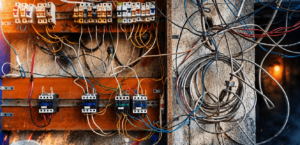
The Israeli army targeted infrastructure in Lebanon, including internet, electricity, and water networks, as well as vital roads connecting southerners to their agricultural lands. It also exerted psychological pressure to prevent the stability of the “Hezbollah” environment.
Targeting infrastructure was a primary objective that the Israeli army was keen to implement with great precision in Lebanon. At the top of this infrastructure are the internet, electricity, and water networks, in addition to the vital and essential roads that connect the homes of southerners in particular to agricultural lands, which constitute a source of livelihood for many of them.
In addition to Israeli military pressure, psychological pressure was also present on the battlefield, which was embodied in an attempt to influence the “Hezbollah” environment by hindering the restoration of stability, especially with regard to reconstruction and the continued targeting of electricity lines, as happened in the past few weeks.
In this regard, unofficial reports indicate that Israel targeted approximately 480,000 solar panels during the recent war.
An expert told “Lebanon24” that targeting 480,000 solar panels represents an installed capacity of between 259 and 264 megawatts, assuming that the capacity of a single panel ranges between 540 and 550 watts. This capacity may decrease to about 192 megawatts if panels with a capacity of 400 watts are used.
He added: “Based on these data, and taking into account the realistic annual utilization rate in Lebanon, which ranges between 18% and 22% (due to factors such as solar radiation, heat, angles, and losses in reflectors and wires), the total annual production ranges between approximately 0.42 and 0.51 terawatt-hours for the higher capacity panels, and between 0.30 and 0.37 terawatt-hours for the lower capacity panels. This means a daily rate of approximately 1.2-1.3 gigawatt-hours in the common reference scenario (540-550 watt panel at 20%), which is enough electricity for about 120 to 140 thousand homes, assuming an average consumption of about 300 kilowatt-hours per month (3,600 kilowatt-hours per year), knowing that this number may decrease to about 93 thousand homes if 400-watt panels are used, or may increase slightly in locations with excellent installation and higher operational performance.”
The expert pointed out that “these estimates take into account that the nominal capacity is a direct current (DC) capacity before conversion to alternating current (AC), and that the practical performance is affected by the Performance Ratio, which usually fluctuates between 75% and 85% depending on the quality, maintenance, and cooling, in addition to design factors such as the DC/AC ratio (often 1.1-1.3), which may cause partial “clipping” of production during peak hours in exchange for boosting production during the rest of the day.”
Source:
Special to Lebanon24
source: 961 today