In a remarkable development, observers believe that October 13, 2025, will remain etched in memory as a pivotal historical moment in the course of modern diplomacy in the Middle East. In the Egyptian city of Sharm el-Sheikh, world leaders not only gathered to celebrate the end of the hostage crisis, the ceasefire, and the start of peace talks, but also to offer support for an ambitious vision aimed at revitalizing, rebuilding, and achieving shared prosperity in the region.
Thanks to this vision, a long era of fear and stagnation has begun to give way to optimism and hope, as the efforts of Arab, Islamic, and Western countries have combined in a unified endeavor based on replacing stagnation with progress, and isolation with integration.
For the first time in a century, a genuine consensus has emerged reflecting a new understanding that the Middle East, torn apart by disputes and the wounds of its colonial past, can weave a new fabric of cooperation. What began as a truce in Gaza quickly evolved into something beyond that: the first building blocks of a renewed partnership. Under this umbrella, stability is no longer imposed by force, but is shaped by providing shared opportunities, and peace is no longer just a temporary truce, but a launchpad towards prosperity.
However, it cannot be denied that the progress in Gaza will witness some setbacks and challenges. But what is remarkable is that, for the first time in decades, regional countries have unanimously condemned the practices of armed groups present on their territories.
Syria: The Missing Cornerstone in the Edifice of Peace
However, there are two essential pieces still missing to complete this solid structure of peace. First, Syria: this country, exhausted by years of long war, stands today at a crucial crossroads, where it will form a real test of the ability of this new regional order to endure. No edifice of peace can be completed while one of the oldest civilizations in the world remains in ruins and destruction. The winds of reconciliation that blew from Gaza must cross borders to reach Syria.
The US Senate has proven its foresight when it voted to repeal the Caesar Act, which played its moral role at a certain stage, but today it is hindering efforts to rebuild an entire country. The House of Representatives is expected to complete this step soon.
In 2019, when Congress passed this law, the world was facing unacceptable atrocities. But Syria today, after December 8, 2024, and with the inauguration of a new government, has reopened communication channels with Turkey, Saudi Arabia, the United Arab Emirates, Egypt, and Europe, and has begun a quiet path towards normalizing relations with Israel.
On May 13, 2025, the President announced his intention to lift sanctions, before the executive decision was issued on June 30, turning the course of sanctions from a punitive policy to a policy of constructive partnership.
Observers believe that lifting sanctions is not just an act of charity, but a wise strategy that allows the rebuilding of infrastructure, opens the way for investments, and dries up the sources of extremism by creating a thriving economy.
In this context, twenty-six senior Christian clergymen in Syria addressed an appeal to Congress to end the sanctions, warning that they have become a direct cause of the shrinking Christian presence in the country.
Lebanon: The Second Front
While Syria recovers through the normalization of relations, it forms the first pillar of Israel’s northern security framework. The second pillar is the disarmament of Hezbollah in Lebanon and the opening of direct security and border dialogues with Israel.
The 2024 cessation of hostilities agreement, brokered by the United States and the United Nations, failed to achieve a real settlement due to the lack of a clear implementation mechanism, due to considering dealing with Israel a crime. Iran continued to fund Hezbollah, while the Lebanese army continued to suffer from a lack of funding and powers, and the government remained in a state of complete paralysis.
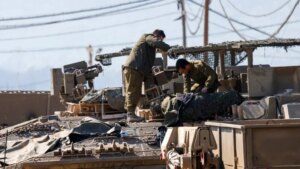
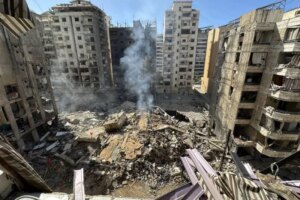
Today, Israel continues to occupy five strategic sites along the “Blue Line” and carries out daily strikes, while the principle of “one army” in Lebanon remains just a slogan that does not reflect the actual reality of Hezbollah’s influence.
Earlier this year, the United States presented a “last attempt” plan that included gradual disarmament and economic incentives under international supervision, but Lebanon rejected it due to the party’s influence within the cabinet.
With every step Damascus takes towards stability, Hezbollah becomes more isolated. Observers believe that this group is obstructing Lebanon’s sovereignty, impeding investments, and preventing the establishment of a strong and effective state, while regional partners are ready to pump investments as soon as legitimate authority is transferred to the Lebanese army exclusively.
Observers warn that any delay in this file may push Israel to act alone, which could have dire consequences. They believe that disarming Hezbollah is not just a security requirement for Israel, but a golden opportunity for Lebanon to rebuild its institutions, economy, and restore its people’s confidence in their state.
Observers also point out that Washington is ready to provide diplomatic cover for the party’s transition to political action only, and link international aid to an assessment of the progress made towards building a state in which there are no weapons outside the scope of legitimacy, while intensifying support for the Lebanese army, which this month received more than $200 million in additional funding.
You can find related content on:
source: 961 today