This decision, according to a report by the Army Recognition website, represents a precedent in Japanese history, as it opens the door to a deeper review of its defense policies that have long restricted the military use of nuclear energy since the end of World War II.
The committee submitted its proposal to the Ministry of Defense last September, stressing that the next generation of Japanese submarines must have a greater ability to cover distances and remain underwater for long periods, in addition to carrying long-range missiles, which are specifications that are difficult to achieve with traditional diesel engines or batteries.
The committee also called for the adoption of advanced technological solutions to increase the ability of submarines to conceal and endure, considering that “possessing nuclear submarines has become a strategic necessity” in light of the escalation of tensions in the Indo-Pacific region.
For his part, former Japanese Navy Commander Kazuki Yano said, “Nuclear submarines give Japan superiority in secrecy, mobility, and range,” stressing that Tokyo “already possesses the industrial capabilities to build them, if this is legally permitted.”
However, this path faces major legal and political obstacles, as the Japanese Atomic Energy Law restricts any military use of nuclear technology, while the “Three Nuclear Principles” prohibit the manufacture, possession, or receipt of nuclear weapons.
Despite the technical enthusiasm, Chief Cabinet Secretary Yoshimasa Hayashi confirmed in previous statements that the government “does not currently plan to possess nuclear submarines” within current laws.
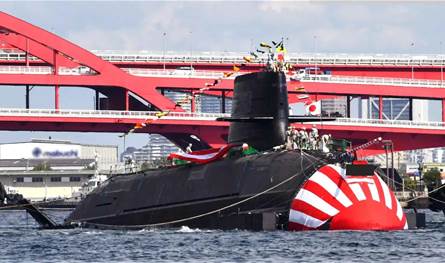
Currently, Japan continues to expand its conventional fleet, which includes 22 Taigi and Soryu-class submarines, the newest of which are equipped with lithium-ion batteries that give them a longer ability to operate silently in the depths.
Analysts believe that the AUKUS agreement between the United States, Britain and Australia, which allowed Canberra to obtain nuclear submarines, revived the debate within Tokyo about the future of its defense capabilities.
Experts believe that this discussion is not limited to the technical aspect, but rather indicates the breaking of the psychological restrictions that shackled Japan for decades after World War II. With the escalation of Chinese and North Korean threats, Japan appears to be preparing for a quiet return to the samurai spirit, but with a nuclear shadow this time.