The project’s timetable has witnessed a remarkable modification. After its launch last June, there was talk of completing the project within 90 days. The currently announced executive goal is to start partial operation in October 2026, with the work to be completed to reach full operation later.
In this context, the Minister of Public Works and Transport, Fayez Rasamni, recently announced that “the first plane that will take off from Qlayaat Airport in early October will be to the Kingdom of Saudi Arabia,” noting that “the plane that will take off from the airport is now in Beirut.”
Indeed, on August 26, the first plane belonging to the airport operating company, Sky Lounge Services, arrived at Rafic Hariri International Airport in Beirut. This step falls within the preliminary administrative, technical and logistical procedures to begin actual work in Qlayaat.
Where did the work at Qlayaat Airport reach?
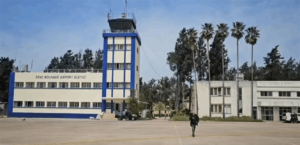
Field indicators reflect that the project has moved to advanced stages compared to what it was when it was launched. So far, the passenger building has been expanded from about 2,000 square meters to 4,700 square metres, an increase of 2,700 square metres. This expansion comes to meet operational and security requirements and accommodate a larger number of travelers, especially security equipment and x-ray inspection devices.
The basic structure of the passenger building is complete, including the iron structure of the sides and roof. The current work is focused on closing the building and implementing the flooring and interior finishes, i.e. the final stage of construction.
Electromechanical works were also awarded, in a step that reflects the project’s transition from basic construction work to the stage of preparing the facility to be able to operate as an actual civil airport.
In parallel, preparations have begun to equip the runway and raise operational readiness, while coordination continues between the Ministry of Public Works and Transport, the Ministry of Interior, the General Directorate of Civil Aviation, and the security agencies.
According to the operating company, these works are moving towards a clear goal: partial operation in the month of October, with the rest of the work being completed to reach full operation.
Offered destinations
During the preparation stages of the project, a group of potential destinations were proposed for the first phase of Qlayaat Airport, including Istanbul, Mersin in Turkey, and Dubai, while consideration was given to expanding the network of destinations later to include Saudi Arabia, Cairo, and Athens.
However, these destinations cannot be treated as a final flight schedule, as the launch of any regular air route requires the approval of airlines and the competent civil aviation authorities, in addition to completing operational and security requirements.
In this context, contacts were made with low-cost airlines, including Ryanair and Pegasus, to explore the possibility of operating flights from Klayaat.
This point is of particular importance, because the success of the airport will not be determined only by the completion of the passenger terminal or the readiness of the runway, but rather by its ability to attract airlines that are actually committed to operating regular flights at prices capable of providing sustainable demand.
Qlayaat will not be an alternative to Beirut Airport
The official position that accompanied the launch of the restart project was clear that Klayaat Airport is not a substitute for Beirut Airport, but rather part of a more integrated Lebanese air infrastructure. Therefore, Rafic Hariri International Airport will remain the main airport in the country, retaining the largest share of passenger traffic and the network of airlines and international destinations, especially those linked to Beirut, Mount Lebanon and the rest of the regions.
On the other hand, Qlayaat is supposed to play the role of the second international airport, with an initial focus on serving Akkar and the north and attracting part of the air traffic that is currently concentrated in Beirut.
Its geographical location can also make it more connected to regional flights, especially towards the Gulf and the Arab world, with the possibility of attracting low-cost airlines.
114 thousand passengers to begin with
The targeted capacity in the first year of restarting Qlayaat Airport is about 114,000 passengers annually, to gradually rise to more than 600,000 passengers annually in the fourth year, reaching about 9,600 flight movements annually upon reaching that stage.
This progression is logical, because operating an international airport does not stop when construction work is completed. The airport requires airlines, air routes, and regulatory approvals, as well as security, customs, handling, baggage, communications, navigation, and operational testing services.
More than one project for Akkar
For Akkar and the north, this project has a dimension that goes beyond civil aviation itself. Operating an international airport in Qlayaat could relieve residents of the north of the need to go to the capital, Beirut, to travel by air, and open the way for greater economic, tourism, and commercial movement in the region.
In the future, the airport can also play a role in supporting air freight and agricultural exports, especially if the network of destinations and associated logistics services expands.
At the national level, the presence of a second international airport also gives Lebanon a greater margin in distributing air traffic and reduces complete dependence on a single international air facility, which constitutes a kind of strategic reserve in the event that Beirut airport traffic is exposed to any disturbance.
The real test starts with operation
So far, data indicate that the Qlayaat project has made clear progress: the passenger terminal has expanded, its basic structure has been completed, internal and electromechanical works are progressing, and preparation for the runway has begun, while the legal and operational frameworks are crystallizing, but the most difficult stage has not yet begun.
True success will not only be measured by opening the building doors or taking off the first plane, but rather by the airport’s ability to secure regular and sustainable flights, attract airlines, expand the network of destinations, offer competitive prices, and operate efficiently in parallel with Beirut Airport.
Accordingly, the month of October today appears to be the most important implementation phase of the project, not as the end of the works, but as the beginning of the actual test of Lebanon’s ability to operate a second international airport.
Pending this, the most accurate picture appears to be that Qlayaat Airport has moved from the stage of promises to the stage of implementation, and that Lebanon is moving towards a model based on two international airports operating in parallel, rather than on one airport that alone carries the entire international air traffic in the country.