“Lebanon Debate”
A new immediate evacuation warning in Tripoli brings the issue of damaged buildings back to the forefront, this time from the Al-Zahriyah – Khan Al-Askar area, where an engineering inspection showed structural damage to one of the buildings that threatens the safety of residents and passers-by. This measure comes after a similar warning issued by the municipality, last Monday, to a building in Al-Qubba – Al-Baqar, in light of continuing fears of a repeat of the collapse incidents that the city witnessed.
According to “Lebanon Debate” information, the Municipality of Tripoli, through the Engineering Department – Buildings Department, sent a warning to the owners and occupants of the building located within Property No. 216 in the Al-Zahriyah – Khan Al-Askar area, asking them to evacuate immediately, based on the results of the inspection of its structural condition.
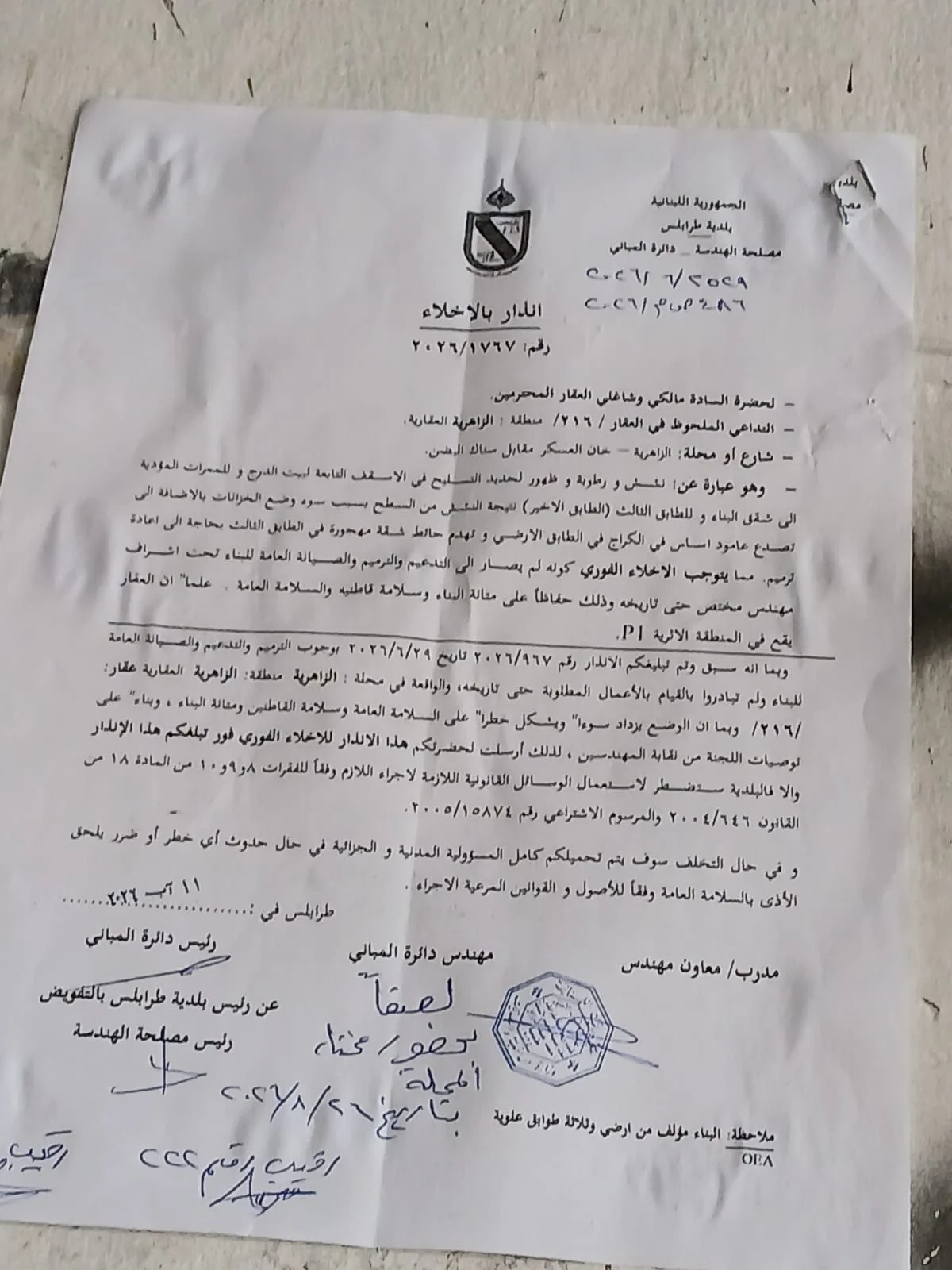
The warning indicated that “the building suffers from damage and problems in the roof that require the implementation of restoration, strengthening and maintenance work, in addition to the necessity of treating one of the columns in the garage on the ground floor and strengthening an adjacent wall,” according to what was stated in the engineering report.
He explained that “the municipality had previously asked the owners to take the initiative to carry out the necessary works, but they had not been completed until the date of issuing the warning,” while the inspection showed “the continuing danger to the building and the safety of its occupants and passers-by.”
Based on these data, the municipality requested “the immediate evacuation of the building,” warning the owners to “bear full civil and criminal liability in the event of any harm to people or public safety.”
Al-Zahriyah’s warning does not come in isolation from similar measures in other neighborhoods of the city. Last Monday, the municipality of Tripoli issued an immediate evacuation warning for a building in the Al-Qubba-Al-Baqar area, at the first intersection after the medical facility, after inspections showed “the worsening of its structural problems and its condition becoming worse.”
The warning was directed to the owners and occupants of property No. 4994 in the Zaytoun Tripoli real estate area. “Water leakage and cracking were detected on various floors, which led to cracks in the concrete and the exposure of rebar, in addition to superficial concavities in the ceilings and bridges of some floors, and moderate cracks in a number of bridges.” In addition, “a large concavity in the ceiling of the last staircase and the balconies, and moderate cracks in the walls of the lower and sixth floors.”
Also, “a previous warning was sent to those concerned on June 13, 2026 to carry out immediate restoration and strengthening work and general maintenance, but the required works were not carried out,” which, according to the municipality, exacerbated the threat to the durability of the building and the safety of residents and passers-by.
The municipality asked the owners and occupants of the Al-Qubba-Al-Baqar building “to vacate it as soon as they are notified of the warning,” stressing that it “will resort, in the event of non-compliance, to available legal means to take the necessary measures, while holding the violators civilly and criminally responsible for any danger or accident that affects public safety.”
The two warnings reveal a common denominator: restoration and strengthening works that had previously been requested to be implemented but were not completed, before engineering inspections confirmed the continuation or worsening of the danger, and called for immediate evacuation.
These developments come as the repercussions of the collapse of the Bab al-Tabbaneh building last February are still present in the city, after the disaster resulted, according to the final tally of the Ministry of Health, in the fall of 13 victims and the injury of 8 people. This was followed by a popular movement and evacuations of damaged buildings, amid demands to accelerate detection and reinforcement and provide alternatives for families who are forced to leave their homes.
With the succession of evacuation warnings, the protection of residents remains linked to following up on the implementation of the required engineering procedures and providing shelter when needed, in a way that prevents families from remaining inside buildings proven to be a threat to their safety, and prevents a new warning from turning into another collapse incident.