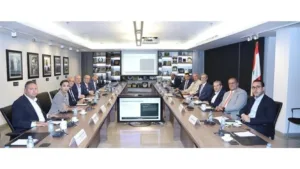
Simultaneously, bilateral business meetings (B2B) were held between 50 businessmen from the Emirati delegation and about 120 businessmen from the Lebanese side in various sectors of trade, industry, agriculture, tourism, information technology, oil, gas, banking, infrastructure, and services, with the aim of exploring opportunities and researching the possibility of establishing business partnerships between Lebanese companies and Emirati companies. Al-Liwaa wrote: In a very important development that includes indicators that serve the path of stability in the country, the economic bodies hosted the The Chamber of Commerce, Industry and Agriculture in Beirut and Mount Lebanon and the Lebanese-Emirati Economic Forum, in the presence of Deputy Prime Minister Tareq Mitri, Ministers Amer Al-Bassat, Joe Issa Al-Khoury and Kamal Shehadeh, and the head of the bodies, former Minister Mohamed Choucair.
A high-level Emirati delegation headed by the Emirati Minister of Foreign Trade, Dr. Thani bin Ahmed Al-Zeyoudi, also attended, and included about 90 prominent Emirati businessmen, investors, and economic leaders, in a visit that carried more than one message, most notably the transition of Lebanese-Emirati relations from the space of solidarity and support to the space of partnership, investment, and joint projects.
The forum, which was held at the Seaside Arena, was a practical step forward to translate the political rapprochement between the two countries into a broader economic and investment path, through direct meetings between the two private sectors, the signing of five memorandums of understanding, the launch of a joint Lebanese-Emirati business council, in addition to specialized sessions that dealt with investment in infrastructure and reconstruction, the prospects for investment partnerships and the role of the private sector.
Perhaps the most prominent thing that the forum reflected is that Lebanon is no longer presented to the Emirati investor as an arena in need of aid only, but rather as a market that possesses opportunities in multiple sectors, while the Lebanese side stressed that the next stage is supposed to be based on commercial investment and economically feasible partnership. Al-Akhbar wrote: The Emiratis’ interest in opportunities in Lebanon “is limited to sovereign facilities such as the airport, the port of Beirut, or the port of Tripoli,” and one of the conference participants says, “They see that all other investments are meaningless.” Without such investment in the airport or port, that is, in the main sea and air crossings.” They were originally “investors in Lebanon for years, in real estate or in other commercial or tourism institutions, but they learned that the return on these investments has no political weight and cannot be considered a significant financial return.”
However, some Lebanese businessmen indicate that interests are not specifically limited to the port or the airport, but rather could be related to programs for managing the flows of goods, money, and individuals through these facilities, and a clear tendency has emerged among them that they want to invest in programs for managing personal status and issuing identities and perhaps passports as well, the source says.
The head of the Beirut Chamber of Commerce, Mohamed Choucair, hinted at Emirati readiness for this type of assistance and said: “Lebanon is entering a promising phase with the start of reconstruction and the development of infrastructure and economic and service facilities.” On the other hand, Vice President of the Federation of Emirates Chambers, Abdullah Sultan Al Owais, expressed the desire for investment by saying: “Commercial relations between the two countries go back to the 1970s, and there is a desire to pave the way for increasing the volume of trade and investments between Lebanon and the Emirates.”
The participation of about 87 Emirati companies created an atmosphere of optimism, especially since the delegation represented broad sectors, including technology, artificial intelligence, e-government, logistics services, food security, agriculture, industry, energy, health, tourism and gas. Participation takes on additional significance in light of the continuing political and security risks, suggesting that the UAE has begun to explore opportunities instead of waiting for stability to complete.
But the Emirati message does not appear to be a promise of immediate investments, but rather a willingness to test specific projects, provided that economic feasibility and the availability of a legal and regulatory environment that protects the investor and facilitates implementation. On the other hand, the Lebanese side seemed more aware of the necessity of moving from “give us” to “we have opportunities,” that is, presenting Lebanon as a trading partner that possesses assets, competencies, and projects, and not as an economy waiting for help.
The UAE Minister of Foreign Trade, Dr. Thani bin Ahmed Al Zeyoudi, set the clearest standard for the next stage: The success of relations is not measured by meetings and statements, but rather by investments, companies and projects that turn into reality, while giving the private sector the primary role in growth, innovation and job creation. This vision is reinforced by non-oil trade numbers between the two countries, which reached $4.2 billion in 2025, an increase of 35.6%. The UAE presents itself as a platform for Lebanese companies to expand regionally and globally, benefiting from a network that includes 38 comprehensive economic partnership agreements and provides access to more than 3.5 billion people.
In turn, Hamad Sayyah Al Mazrouei, Undersecretary of the Department of Economic Development in Abu Dhabi, confirmed that “the UAE is ready to receive Lebanese companies and talents as a platform for regional and global expansion, especially in infrastructure, energy, logistics, technology, food security, tourism and health.” The head of the Lebanese-Emirati Business Council, on the Emirati side, identified technology and services as a possible first gateway, given the Lebanese competencies and the possibility of launching these sectors with investments that are less complex than major industrial projects. The Minister of Economy and Trade, Amer Al-Bassat, linked transforming Lebanon’s potential into actual growth with reforming the banking sector, the financial framework, public services, the business environment, and consolidating state sovereignty, calling for exploring a special economic partnership with the UAE to deepen trade, investment, and transfer of knowledge.