The agreement reached by US President Donald Trump with Iran was supposed to open the door to resuming navigation in the Strait of Hormuz and relieve pressure on the global economy, but a disagreement over the interpretation of one of its paragraphs turned the agreement into a starting point for a new military escalation between the two sides.
According to a report published by the Wall Street Journal, the dispute revolves around the fifth paragraph of the memorandum of understanding, which stipulates that Iran will make the necessary arrangements to resume navigation through the Strait of Hormuz, and then work with the Sultanate of Oman to determine the mechanism for its management in the future, in addition to its pledge to ensure safe passage and remove military obstacles, including mines.
But the interpretation of this paragraph differed between the two parties.
The Trump administration considered the text to constitute a mechanism to reopen the Strait and ensure freedom of navigation, while hardliners inside Iran saw it as an implicit American recognition of Tehran’s exclusive right to manage the Strait of Hormuz and use it as a strategic card of influence.
The newspaper quoted an American official familiar with the negotiations as saying that Washington and Tehran live on “two different planets” in interpreting the agreement.
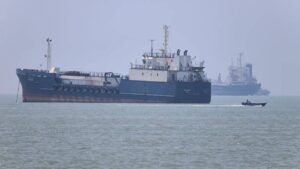
In recent days, the US Central Command announced the implementation of a new wave of strikes against Iran, targeting coastal radars, air defense systems, missile and drone equipment, in addition to speedboats, stressing that Iran does not control the Strait of Hormuz.
These strikes came after the US military announced that the Iranian Revolutionary Guard forces again opened fire on commercial ships as they were crossing the strait.
The Wall Street Journal believes that the fifth paragraph makes Iran responsible for reopening the strait, but it does not give the United States any explicit role in securing navigation, which is what Tehran exploited to attack ships using a southern sea corridor coordinated by Washington near Omani waters.
It also indicated that the Revolutionary Guard pushed for a strict interpretation of the agreement, based on Iran being considered the only body authorized to regulate traffic in the strait, while proposing to impose future fees on ships, and requiring them to obtain approvals and approved insurance from an Iranian body established for this purpose.
In the conclusion of the report, the essence of the dispute is not only related to navigation, but rather to the question of who has the right to manage the Strait of Hormuz, which prompted analysts to describe the fifth paragraph as “the most dangerous sentence in the Middle East,” considering that one line in the interim agreement did not postpone the confrontation, but rather moved it to a new arena entitled control of the most important energy artery in the world.