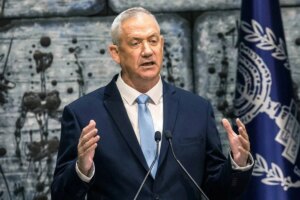
The Director General of the Israeli Ministry of Defense, Major General Reserve Amir Baram, issued a harsh warning of a serious delay in building the Israeli military force for the coming years, considering that the withdrawal and procrastination in budgets threaten Israel’s ability to implement the plan to arm the Israeli army for the next decade. In the background of this warning, Baram links the danger of Iranian expansion, the crisis of interceptor missile stocks, and the need to expand partnerships from India and the UAE to Greece and Cyprus, without considering this as an alternative to the relationship with the United States.
According to a report by journalist Avi Ashkenazi in the Israeli newspaper “Maariv”, the Director General of the Israeli Ministry of Defense, Major General Reserve Amir Baram, said during the Herzliya conference, “Building the long-term strength of the State of Israel is seriously lagging behind. If we continue to act as a state in this way, the danger to the appropriate security preparedness of the State of Israel will become very great.”
Baram touched on the performance of the Israeli Ministry of Finance, saying: “The Budgets Department in the Ministry of Finance, which sees the repercussions of the military reality as a passing accounting event, dissipates the government’s ability to implement decisions that were previously taken regarding building a long-term force.”
The report addressed the crisis in the stock of “Haetz” missiles, as Baram explained that he was forced to use emergency powers to deal with the crisis, saying: “Thanks to the emergency measures that we took in real time, Israel today has a stock of Haetz, David’s Sling, and Iron Dome that increases during the fighting. But the mission is not finished.”
He added: “In the last year, as Director General, I had to activate all emergency powers, even in the absence of budget coverage. We attacked choke points, carried out decisive intercontinental purchases of raw materials, signed export deals that expanded local production lines, and recruited a workforce dedicated to industries. Thanks to these emergency measures that we took in real time, Israel today has a stockpile of Hetz, David’s Sling, and Iron Dome that has been increasing during the war.”
Regarding the meaning of the partnership with Greece and Cyprus, Baram said, “The war made clear to all parties in the region the price of Iranian arrogance. It created an identity of interests to form a broader alliance, from India, through the UAE, to Greece and Cyprus. Israeli strengths in technology, proven operational experience, and security innovation, along with the financial strength of the Gulf, may allow the establishment of a new economic security front.”
He stressed that “expanding our strategic partnerships is not an alternative to partnership with the United States, but it will allow us to increase Israel’s margin of maneuver and strength in the international arena, and it will also allow us to diversify our strategic pillars.”
Baram warned again against the budget drawdown, which has been delaying for months the implementation of the plan to build the Israeli army’s strength for the next decade, a plan estimated at 350 billion shekels, saying: “Building the long-term strength of the State of Israel is seriously delayed.”
He added: “The Budgets Department in the Ministry of Finance, which sees the repercussions of the military reality as a passing accounting event, dissipates the government’s ability to implement decisions that were previously taken regarding building a long-term force, at a time when the Iranian enemy is expected to invest huge sums in capacity building in the second half of 2026, equivalent to our entire contract plan.”
He continued: “We are walking on a bumpy bureaucratic road in which there is no implementation of a strategy or even industry and management. Unfortunately, after nearly 3 years of war, if we continue to act as a state in this way, the danger to the appropriate security preparedness of the State of Israel will become very great.”
Regarding the Iranian threat, Baram said: “The agreements that are taking shape in the world, which could pump hundreds of billions of dollars to Iran, may dramatically accelerate the building of its power. In the face of such a growing threat, the State of Israel must prepare by building an appropriate force and push towards a new regional architecture, first and foremost with our strategic ally, the United States, and with other parties.”
In his approach to the partnership with Washington, Baram said: “We should not judge current American policy by narrow domestic tools. What is seen in Israel, by some people, as weakness and foolishness, with a supposed disregard for all warning signs on the ground, is seen in Washington as cold, calculated, and realistic risk management in an era of shifting global attention.”
Baram spoke about the differences in priorities between Israel and the United States, saying: “The difference between us is not in understanding the threat, but in prioritizing. For us, Iran is an existential threat, while for the United States it is a chronic regional challenge, while China and the quiet Indian arena are the central challenge. We are thinking about Tehran, and they are thinking about Taiwan. From the Pentagon’s point of view, when American ammunition resources are stretched between helping in ongoing wars and preparing for a possible confrontation in the Taiwan Strait, the continuation of the war in the Middle East is a counter-interest.” For the global positioning of the United States.”
He added: “On the other hand, and based on my deep knowledge of the different opinions within the American system, if there is one thing that Americans hate more than this war that has prolonged them, it is to lose a battle that they had won. In any case, when the United States works according to the concept of America First, our partnership can be based not only on common values, but also on cold interests: A strong, independent and proactive Israel, which stabilizes the Middle East, is the asset that allows the United States to direct its resources to Asia. These are The infrastructure for the upcoming security partnership agreement (MOU), which we are working on developing now, should create security, economic, and strategic benefits for the two countries for many years.”
Baram also addressed the issue of treating the wounded in the Israeli army and implementing the recommendations of the Mor Yosef Committee, saying: “Unfortunately, despite the broad agreement on the necessity of the committee, we are now facing procrastination and obstacles from parties in the Ministry of Finance that are delaying the implementation of the committee’s conclusions. Israeli society, which values its heroes and protectors, will not accept such gaps. Rehabilitation cannot be dropped.”
Between the warning against Iran, the concern about the stock of objections, and the debate with the Ministry of Finance, the deeper message appears in Baram’s words: Israel is not only looking for additional budgets, but rather for a broader strategic safety net, starting from Washington and not ending with Greece and Cyprus.