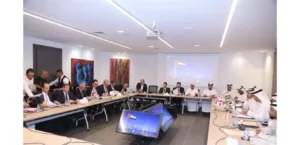
A delegation from the World Bank attended the meeting with Minister Jaber, which included Director of the Beirut Office, Enrique Blanco Armas, Mira Murad, Zeina El-Khoury, Yann Chaouli, Mohamed Qamh, Gael Samaha, and Advisor to the Prime Minister Sati Arnaout.
Also present were the Chairman of the Supreme Council of Customs, Brigadier General Mesbah Khalil, members of the Council, Louay Al-Haj Shehadeh and Charbel Khalil, the Director General of Customs, Gracia Al-Qazzi, and advisors to the Ministry of Finance, Brigadier General Abdel-Muttalib Al-Hinnawi, Claudine Karaki, Zeina Qassem, and Abbas Taher.
The attendees discussed a technical assistance program aimed at enhancing Lebanon’s regional integration in the transportation, trade, and energy sectors and evaluated the available opportunities and reforms necessary to support this approach.
In this context, the World Bank team presented the proposed work approach, which includes studying the conditions of transportation, trade, energy, natural gas, oil infrastructure, and digital transformation, with the aim of identifying future priorities and needs.
After the meeting, Minister Jaber stated: “It was a meeting dedicated to researching a study prepared by the World Bank at the request of the Lebanese government on how to improve communication and trade exchange between Lebanon and its surrounding Arab countries.”
He added: “This issue gains special importance, especially in light of the developments that have taken place in recent days, especially with regard to the Strait of Hormuz and enabling many countries to export. The importance has emerged in terms of the existence of communication between the countries of the Eastern Mediterranean and the Arab depths, such as Syria, Iraq and Jordan, and it also comes at a time when the Kingdom of Saudi Arabia has graciously reopened the field of export of Lebanese goods to Saudi markets.”
He continued: “Hence, Lebanon is called upon to play the role of improving border crossings in terms of performance and installing modern devices such as scanners to create tight control over exports, in addition to establishing coordination between Lebanese customs and Saudi customs through strict procedures that require sending scanner photos of the content of containers of exported goods and materials to Saudi customs.”
Jaber pointed out, “Lebanon today is conducting a study on how to enter into the construction process of the railway on the Hijaz-Jordan-Syria-Turkey route and connect to it by establishing a tunnel between the port of Beirut and the Lebanese depth in the Bekaa, in addition to other projects that the World Bank is contributing to studying, which would coordinate communication between Lebanon and its surrounding countries to facilitate trade and energy exchange, draw electricity from neighboring countries, and restart oil lines to reach the shores of the Mediterranean starting from Lebanon.”
He pointed out that “the study will be comprehensive and ready in the next few months, in coordination with the Lebanese authorities, customs, and the Ministry of Works, Energy, Economy and Industry, to be integrated and look at the trade agreement between Lebanon and the world, and how to revitalize it in the future.”
In response to a number of questions, Jaber stressed “the importance that lies in the World Bank’s work in Lebanon, Syria, Iraq and the Gulf region and being informed of the projects that would be useful to establish to improve communication. We are working for Lebanon to regain its role as an active center in the transit process and mainly exchange movement.”
Jaber stressed “the importance of regional connectivity in light of the changes taking place in the region, while emphasizing the necessity of developing ports and border crossings, modernizing customs administration, and accelerating digital transformation in a way that strengthens Lebanon’s position as a center for trade and logistics services.”
He pointed out that “this meeting constitutes an important step towards strengthening cooperation between Lebanon and the World Bank to support regional integration and stimulate economic growth.”
Minister Jaber received the Minister of Communications, Charles Al-Hajj, and discussed with him matters related to the development of the communications sector and the role of the Ministry of Finance in this regard.