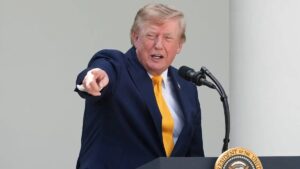
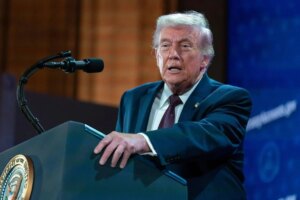
At a time when the United States is engaged in open confrontations on more than one front, from Iran to China and Russia, American reports reveal an unprecedented crisis within the American diplomatic apparatus, after the administration of President Donald Trump left more than 100 ambassadorial positions vacant around the world, including embassies with key allies of Washington.
According to an article by writer Tom Nichols in The Atlantic, this number of vacancies is unprecedented even compared to Trump’s first term, where the number of unfilled positions in the same period was only 45.
The report indicated that the United States today finds itself in a “hot war” with Iran, and a “cold war” with China and Russia, in addition to multiple trade disputes, while Trump continues to talk about the possibility of a clash with Cuba and even annexing Greenland, which may open a confrontation with NATO.
Despite this explosive scene, the writer confirms that the American administration does not show a real interest in strengthening traditional diplomacy by appointing ambassadors capable of managing crises, reassuring allies, and conveying sensitive American messages.
The article quoted the American Diplomatic Staff Association as saying that Trump is “slow in appointing ambassadors,” while nominations in the Senate are stalled due to complex confirmation procedures.
But the writer considered that this “soft” formula hides a different reality, saying that Trump does not even understand the importance of ambassadors, and prefers to grant these positions to his friends and those close to him as political rewards.
He added that some of these “embarrassing” appointments affected major embassies such as Jerusalem and Paris, while figures strongly loyal to Trump were appointed to sensitive diplomatic positions, including Carrie Lake, ambassador to Jamaica, despite her internal political failure.
According to the report, the Trump administration is increasingly relying on “trusted envoys” instead of traditional diplomats, such as Steve Witkoff and Jared Kushner, in addition to the US ambassador to Turkey, Tom Barrack, who is also in charge of the Syria file.
However, the writer described this model as “chaotic and ineffective,” considering that managing major crises such as the war between Russia and Ukraine without accredited ambassadors in Moscow and Kiev “is not efficiency but rather foolishness.”
The article pointed out that some ambassadors are now supervising several regions at the same time, such as the US ambassador to India, Sergio Gore, who has also been entrusted with responsibilities related to Central Asia, even though 4 out of 5 countries in the region still do not have American ambassadors.
The report also revealed that at the beginning of his term, Secretary of State Marco Rubio summoned 30 American ambassadors at once, in a move described as unusual and indicating the possibility of professional diplomats being subjected to political scrutiny.
The writer believes that Trump does not deal with the American state as a public institution, but rather as a private company that he personally owns, where employees and diplomats are viewed either as his supporters or political opponents.
The article also indicated that Trump may have begun to prefer communicating through a narrow circle of trusted people after his first impeachment experience related to the Ukraine file, when officials and diplomats revealed information that harmed him politically.
The report quoted Reuters as saying that foreign governments are now bypassing traditional American embassies, and are instead trying to reach directly the inner circle surrounding Trump.
In a sharp conclusion, the writer considered that Trump’s repeated diplomatic failures, from the tension in relations with China and Russia to the decline in trade wars and the failure to mobilize the support of allies in the Middle East, reflect a deeper crisis in the way Washington manages its international relations.
It seems that the ambassadorial crisis is no longer just an administrative defect within the US State Department. Rather, according to this proposal, it has turned into an indicator of a broader shift in Trump’s governance philosophy, where institutional diplomacy is retreating in favor of a narrow personal network that manages foreign policy with the logic of loyalty, not the state.