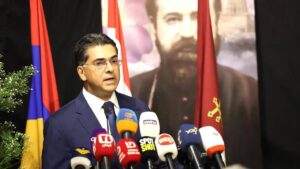
Representative Tony Franjieh affirmed his support for the general amnesty law “in principle,” stressing that the law must not be tailored to suit any party, and that it must guarantee the lifting of injustices and the reduction of penalties within clear controls and exceptions.
Franjieh said that the Marada Movement “belongs to the school of tolerance and pardon,” but he considered that “the devil lies in the details,” calling for premeditated murder, rape, and some other crimes to be excluded from any possible amnesty.
Regarding the political file, Franjieh rejected the accusations against the “Marada” regarding files related to patriotism and coups, saying: “We do not allow anyone to criticize the Marada for his patriotism, and everything that is said about coups are myths invented by well-known parties.”
He also addressed the security developments in the south, considering that some parties “see only the part of the war that serves them,” by focusing on Hezbollah missiles and ignoring the Lebanese martyrs, the continuing Israeli raids and the occupied southern villages, in addition to what he described as Israel’s failure to adhere to the ceasefire for 15 months.
Regarding the negotiations, Franjieh from the House of Representatives stressed that “not all Christians are in favor of direct negotiations,” noting that “the Marada” supported the option of indirect negotiations from the beginning and still supports it.
He added that the President of the Republic, Joseph Aoun, is under great pressure, saying: “We do not envy him what he is going through,” calling on everyone to adopt a patriotic stance at this sensitive stage.
Franjieh’s position comes in light of the sharp political division over the general amnesty law and the course of the ongoing negotiations, in parallel with the ongoing security escalation on the southern front and the internal debate regarding the management of the next phase.