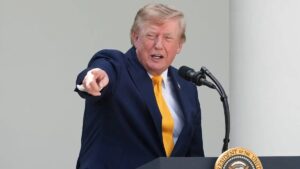
Amid escalating tensions between Washington and Tehran, the possibility of a military confrontation has strongly returned to the fore, after US President Donald Trump renewed his warnings to Iran, through a mysterious post he published at dawn on Sunday on the “Truth Social” platform, in which he spoke of “the calm before the storm.”
In parallel with the political escalation, Israeli sources revealed that there are intensive preparations being made in coordination with the United States for the possibility of resuming the war against Iran, noting that estimates within Israel are 50% likely that Trump will resume the fighting, according to what was reported by Yedioth Ahronoth newspaper.
According to the sources, Israel believes that Iran is trying to buy time and prolong the crisis until after the start of the World Cup on June 11, with the aim of increasing pressure on the United States and delaying any possible military confrontation.
With the US-Iranian negotiations reaching what appears to be a dead end, estimates have increased within Israel that Trump may turn to the option of military action during the next stage.
In this context, the sources spoke about coordination talks being held at the highest levels between the Israeli army and the Mossad, stressing that the Israeli army has raised its level of preparedness to the maximum level in anticipation of renewed war.
The sources suggested that Trump, in the first phase, would be content with carrying out limited strikes against targets inside Iran, such as power plants and bridges, instead of engaging directly in a wide-ranging war.
However, it indicated at the same time that the ground operation option was still on the table, despite Trump’s hesitation and fear of direct military involvement.
According to Israeli estimates, there are three possible scenarios for any ground operation: the first is carrying out a mission to extract enriched uranium buried underground, the second is controlling the Khark oil island, while the third is resuming “Operation Freedom” to direct ships stuck in the Strait of Hormuz.
The sources also confirmed that the naval blockade imposed on Iranian ports will continue, with the possibility of it being tightened during the next phase to increase economic pressure on Tehran.
In parallel, during the past few days, Israeli Prime Minister Benjamin Netanyahu held a series of security consultations to discuss preparations for the possibility of renewed war. However, with the exception of one meeting of the mini-ministerial council, he refrained from holding sessions of the expanded ministerial council, in a move that the Israeli newspaper considered an attempt to “deceive the enemy.”
Trump had recently described the Iranian response to the American proposal as “very bad,” hinting that he might reject the new Iranian offer “after reading the first line.”
On the other hand, informed sources spoke of Tehran’s adherence to its basic conditions, most notably the lifting of the naval blockade on Iranian ports and the release of funds frozen abroad, in addition to the demand to establish a new system for managing the Strait of Hormuz, while maintaining the right to enrich uranium, even if it is accepted to freeze it for a specific period.