Saudi Arabia is moving to propose a new regional approach to contain tensions in the Middle East after the US-Israeli war on Iran, by examining the idea of a “non-aggression agreement” between the countries of the region and Tehran, according to what the Financial Times reported, citing diplomats.
According to Western diplomats, Riyadh views the “Helsinki Agreement,” which was signed during the 1970s and contributed to reducing European tensions during the Cold War, as a model that can be used in the region.
The two diplomats pointed out that the non-aggression agreement is only one of several ideas currently being discussed, in light of increasing Gulf fears since the outbreak of the war about the possibility of the emergence of a “more extremist” Iranian regime after the war, coinciding with the decline of the American military presence in the region.
According to other diplomats, the past months of the war prompted a number of Arab and Islamic countries to re-evaluate their alliances and the regional security structure, amid European support for the Saudi proposal, as European capitals and institutions affiliated with the European Union encouraged the Gulf states to adopt this initiative.
Supporters of the proposal believe that the agreement may constitute a means to avoid future confrontations, in addition to providing guarantees to Iran that it will not be exposed to new attacks.
An Arab diplomat told the newspaper that an agreement similar to the “Helsinki Agreement” would be accepted by the majority of Arab and Islamic countries, as well as Iran.
On the other hand, the newspaper revealed differences in positions between Saudi Arabia and the UAE regarding the regional vision after the war, as Abu Dhabi seemed more stringent towards Iran during the recent confrontation. It also criticized what it considered to be a weakness in the positions of Arab institutions towards the Iranian attacks, stressing at the same time its desire to strengthen its relations with Israel after the end of the war.
Some diplomats also expressed doubts about the UAE’s willingness to join any such agreement.
In contrast, Saudi Arabia and other Gulf countries supported Pakistani-led efforts to reach an understanding between Washington and Tehran to end the war.
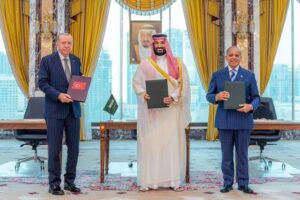
Diplomats also spoke of an increasing rapprochement between Saudi Arabia, Pakistan, Turkey, and Egypt, despite the lack of an official alliance between them, suggesting that the next stage will witness strengthening defense, political, and economic cooperation between these countries.
It is noteworthy that the “Helsinki Agreement” was signed in 1975 between the United States, European countries, the Soviet Union and its allies, and aimed to address security issues and enhance economic cooperation between the competing powers. It was previously proposed as a potential model that could be applied in the Middle East.