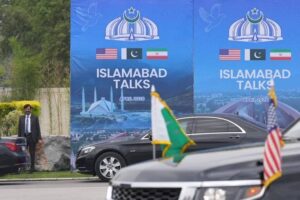
After US Vice President Jay Dee Vance announced the failure of negotiations between Washington and Tehran in Islamabad, Iranian media presented their point of view on what happened during the talks, stressing that the reason for the faltering was “American intransigence” and an attempt to search for flimsy excuses.
Tasnim Agency reported that the Iranian side made strenuous efforts and presented many proposals with the aim of reaching a joint working formula, but what it described as “American exaggeration” hindered any progress. It confirmed that the Iranian delegation succeeded in thwarting efforts to impose concessions related to basic rights, especially in the political, military, and peaceful nuclear technology fields.
She also indicated that the American side tried to obtain concessions that it was unable to achieve during the war, especially with regard to the Strait of Hormuz file and the issue of removing nuclear materials.
For its part, the Iranian Ministry of Foreign Affairs confirmed that the negotiation path is still open, stressing that “the path of diplomacy has not been closed,” and that it remains a permanent method to protect national interests, and indicated that Tehran did not expect to reach an agreement in just one round.
She also explained that the discussions dealt with “complex issues in complex circumstances,” and included new files such as the Strait of Hormuz and developments in the region.
Regarding the course of the negotiations, Tasnim pointed out that the Iranian delegation held at least two meetings with Pakistani Army Commander Asim Munir, in addition to a meeting with Prime Minister Shahbaz Sharif, before the start of direct talks with the American side.
She added that the negotiations took place in two stages, where the delegations held a first round followed by a second round at the expert level. The talks continued for more than 21 hours and witnessed repeated Iranian initiatives to urge the American side to show greater flexibility.
Despite Pakistani mediation and attempts to push for an additional round, the talks ended without reaching an agreement, due to the American side’s insistence on its positions, according to the Iranian narrative.
The agency quoted an Iranian source as saying that “the ball is now in the United States’ court,” calling on Washington to deal with the issues from a realistic perspective, stressing that Iran is “in no hurry” to resume negotiations.
In the same context, Fars Agency reported that there are no current plans to hold a new round of negotiations, indicating that the American team was looking for an excuse to end the dialogue, and that it did not show a willingness to ease its demands.
It is noteworthy that the two parties concluded three rounds of talks before dawn on Sunday, with an initial agreement to resume discussions after a break, but Vance later announced his departure from Islamabad, stressing that Iran refused to respond to American conditions, the most important of which is not to develop a nuclear weapon.
Vance explained that the negotiations ended after 21 hours, stressing that Washington’s main goal is to obtain conclusive guarantees that Iran will not seek to possess a nuclear weapon or develop the capabilities necessary for that.