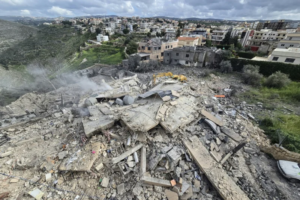
Military operations in southern Lebanon are witnessing a rapid escalation, as the circle of clashes expands to include border villages and hills of strategic importance, indicating that the conflict is turning into a more complex phase. The battle is no longer just an exchange of blows, but rather military objectives intertwine with political considerations related to the negotiation process. At the same time, new field data is emerging that raises questions about the extent of Israeli progress and the possibility of turning it into a permanent gain, versus the ability of the other party to withstand the pressure and redirect the battle towards long-term attrition.
In this context, the military expert, retired Brigadier General Bassam Yassin, confirmed in an interview with: “The Israeli forces were able to reach the town of Al-Bayada, unlike what happened in previous years,” noting that “the goal is to advance towards the line where they were previously stationed at a depth of about 18 kilometers, and to continue this path towards Beaufort Castle, with the aim of tightening control over the high hills and strategic sites.”
He adds that this progress raises questions about whether it represents a new Israeli line, and whether it will lead to expanding the scope of operations or imposing different parameters on the negotiating table, pointing out that “these issues are still open and unresolved so far.”
Yassin points out that “the Israeli forces are fighting the battle without caring about the extent of their losses,” considering that “the announced numbers do not reflect the actual reality, in light of what he described as large losses as a result of the violent clashes taking place in the south, where confrontations continue at a high rate.”
On the other hand, he explains that “Hezbollah is adopting a strategy based on luring Israeli forces to specific points of engagement, to carry out ambushes and focused targeting operations,” explaining that “the party does not cling to the ground except in locations where it can inflict direct losses on the advancing forces, as is happening in the town of Khiam, which has witnessed confrontations since the beginning of the battles.”
He believes that “the course of the war does not suggest that it can end soon, especially in light of the continuation of escalatory goals and intentions, and the faltering course of negotiations,” considering that “Israel relies on the logic of military force in managing this file, and does not seem willing to rush toward a settlement.”
Yassin concludes by stressing that “Hezbollah has the longevity to continue the confrontation despite the scale of the escalation and the Israeli military capabilities,” stressing that “the experience of the years extending from 1982 until 2000, and then the capacity-building phase until 2018, shows that the confrontation is not limited to the party only, but rather includes a wide incubating environment in the south, where the population is directly or indirectly involved in the defense process.”