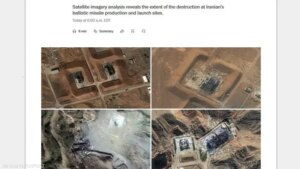
Maariv newspaper reported in a detailed report that next week, which extends from the end of March until the beginning of April 2026, may witness a major Iranian missile escalation, based on a careful study of weather maps and satellite images.
According to the report, variable cloud systems are expected to cover large areas of Iran, which could provide Iranian missile capabilities with “tactical cover” that makes it difficult for Israeli fighter jets and drones to detect moving launchers.
The newspaper explained that the usual Iranian strategy depends on exploiting cloud-filled skies to remove launch pads from fortified sites, carry out rapid launch operations, and then return to tunnels and bunkers hidden by clouds.
According to the analysis, the weather is expected to be cloudy starting Sunday, with heavy clouds on Monday morning, making the dawn hours an important operational period. As for Tuesday, the weather may witness light rain and intermittent cloudy skies, making intelligence gathering operations more difficult.
The report indicated that Thursday is considered the most “dangerous,” as the sky is expected to be completely covered by clouds, providing ideal conditions for launching launchers without being exposed to clear aerial detection. On the other hand, the clouds are likely to clear on Friday and Saturday, bringing back ideal viewing conditions for intelligence agencies.
The report focused on two main regions: western Iran and the Tehran region. In the Kermanshah and Khorramabad regions, mountainous terrain is mixed with low clouds and morning fog, making it more difficult to spot launch pads emerging from rock tunnels.
In Tehran and Isfahan, where strategic missile bases are located, intermediate cloud layers may confuse the accuracy of laser-guided munitions or optical sensor systems, giving operators additional time to carry out their missions.
The report stated that cloudy weather also affects the Iranian air defense system. While radars work efficiently in various conditions, the effectiveness of electro-optical detection systems declines under dense clouds. However, these conditions may force attacking aircraft to fly at lower altitudes for better visibility, exposing them to fire from anti-aircraft guns and short-range defense systems.
The newspaper added that Iran has historically not tended to exploit periods of changing seasons to carry out offensive activity, given the dual challenges that low clouds impose on its opponents: the difficulty of detecting the movement of platforms and the reduced response time to closing fire circles.
This analysis comes in light of the continuing military confrontation between Iran and Israel, as the past days have witnessed repeated missile attacks and intense air responses on military facilities inside Iran.
With temperatures rising this week to about 26 degrees Celsius, the newspaper believes that “the sky, not the temperature,” is the primary factor in determining the level of preparedness and the pace of events on the ground.
The Israeli reading of the weather data shows the extent of anticipation for a stage that may be decisive on the ground, while the possibilities of escalation or calm are still linked to intertwined military and political factors.