While US President Donald Trump’s statements may suggest the possibility of reaching an agreement with Iran, the facts point to a parallel escalatory path being considered within the corridors of the Pentagon, where military options are being considered that could radically change the course of the war.
According to a report published by the Iranian Maariv, Trump hinted through his platform that the Iranians are “begging for a deal,” stressing that they have been “completely destroyed militarily,” but at the same time he warned that “time is running out,” calling on Tehran to deal seriously before it is too late.
Despite this rhetoric indicating the possibility of ending the war, Axios reported that the US Department of Defense is working on preparing a set of military options, including directing a “decisive strike” against Iran in the event that the diplomatic path fails, especially if the Strait of Hormuz continues to be closed.
The proposed plans include four main scenarios, the most prominent of which is controlling Kharg Island, which is the Iranian oil export center, or invading Lark Island, which is considered a strategic location to monitor navigation in the strait, in addition to the possibility of controlling Abu Musa Island and other islands, or targeting ships transporting Iranian oil.
Options also include more complex operations, including a ground intervention inside Iran to find a stockpile of enriched uranium, or launching a massive air campaign to destroy nuclear facilities and prevent Tehran from obtaining sensitive materials.
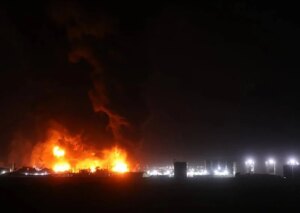
According to sources in the White House, a final decision has not yet been taken regarding these scenarios, as any ground operation is currently classified as “hypothetical,” but the initial trend may begin with an escalation of bombing, especially on power plants and vital infrastructure.
In this context, White House spokeswoman Caroline Levitt stressed that “the president is not joking, and he is ready to unleash hell,” in a direct warning to Iran against any miscalculations.
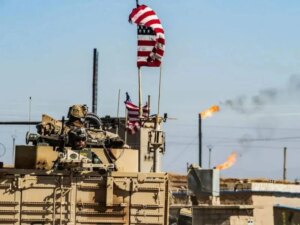
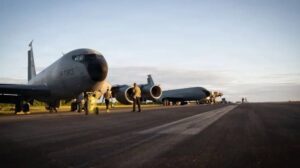
On the field level, the United States continues to strengthen its military presence in the region, with the deployment of fighter squadrons, Marine forces, and thousands of soldiers from the 82nd Airborne Division, in a move that reflects preparation for escalatory scenarios.
On the other hand, Iranian Parliament Speaker Mohammad Bagher Qalibaf warned of a plan to target one of the Iranian islands with the support of a regional country, alluding to the UAE, threatening a “harsh and unlimited” response to that country’s infrastructure.
Despite the escalation of mutual threats, mediation channels remain open, as parties from Pakistan, Egypt, and Turkey seek to arrange a meeting between the two sides in a final attempt to avoid an all-out regional war.
In sum, the discrepancy between the negotiation discourse and the escalation plans reveals a dual strategy led by Washington, combining military pressure and betting on diplomacy, at a pivotal moment that may determine the direction of the war in the region.