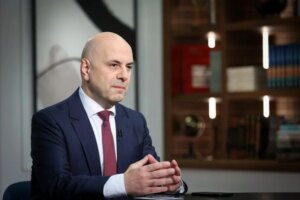
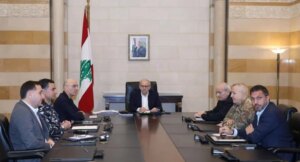
Prime Minister Nawaf Salam explained in an interview with Al-Hadath TV that the war was imposed on Lebanon, and was not a decision taken by the state, stressing that the country suffered heavy losses as a result of this situation.
Salam said: “The war was imposed on Lebanon and it was not our choice.” He added: “We hoped that whoever brought us into the war would be rational before taking the risk again.”
He also drew attention to the humanitarian cost of the escalation, considering that “each of Hezbollah’s six missiles cost 10,000 displaced Lebanese,” and noted that the party’s missiles, in addition to their severe damage, “threatened the government’s credibility.”
Regarding the arms file, Salam acknowledged that “Lebanon is many years behind on the path to arms control,” stressing that “the ministerial statement that stressed arms control gained Hezbollah’s confidence,” stressing that “we will not back down from the government’s decisions to restrict arms,” and that “weapon control has become more urgent today after the cost of the support war.”
Salam added: “I do not call for a confrontation with Hezbollah, but I do not accept submitting to its blackmail,” continuing: “Hezbollah’s threats will not frighten us,” considering that “Hezbollah’s threat aims to prevent us from asking about the reasons we live.” He also confirmed: “I informed the army commander and the government of my refusal to submit to Hezbollah’s blackmail,” stressing that “there was no shouting or any friction with the army commander.”
Regarding a statement said to be attributed to officers in the army, Salam said that the statement was “suspicious,” considering that “black rooms were behind the statement of what was said to be by national officers in the Lebanese army.”
As for the negotiation file, Salam announced that “we have dropped the concept of prohibiting negotiations with Israel,” explaining that “there is no agenda yet for negotiations between Lebanon and Israel,” but “the negotiation initiative is still in place by us,” noting that the government “is seeking to form an inclusive national delegation to negotiate with Israel.”
These statements come in light of the continuing security tensions and the repercussions of the war on the political and humanitarian situation in Lebanon.