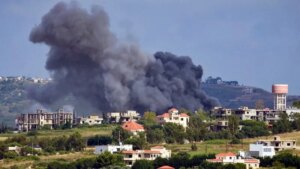
In an effort to oppose the trend of escalation, and with great caution, initiatives and efforts sponsored by the United Nations are progressing with the aim of achieving a ceasefire, which is almost becoming a far-fetched illusion rather than a realistic option.
The recent visit of Secretary-General António Guterres to Beirut, and the previous move by Special Coordinator Jeanine Hennis-Plasschaert, have not yet reached the stage of practical solutions, according to what informed political circles see. The only reason for this is that the United Nations, which is theoretically based on Resolution 1701, practically lacks the necessary mechanisms to impose it, especially in light of the rapid changes in the field balance of power and the absence of a clear American will to impose a ceasefire.
These circles indicate that the French initiative tried to rely on an internal Lebanese consensus, and linked the ceasefire to a set of measures that include strengthening the role of the state and the army, but it faced two decisive factors: first, it was effectively referred to the Israeli position with American cover, and second, the decline in Hezbollah’s internal decision-making margin in favor of a closer connection to regional calculations, specifically with Iran.
Accordingly, circles believe that the chances of any European or international initiative have become very limited in the foreseeable future, especially after the visit of French Foreign Minister Jean-Noel Barrot to Israel. The conflict is no longer limited to Lebanon and Israel, but rather has become part of a broader conflict between Tehran and Tel Aviv, which makes the ceasefire decision go far beyond internal Lebanese calculations.
Based on the current indicators, it is clear that retreat is currently out of the question for the party, as circles say, given that the confrontation is linked to the balance of deterrence with Israel, and not as a separate front that can be frozen by an internal political decision, and that any ceasefire without clear gains may be interpreted as a concession at a sensitive regional moment, while Israel’s strategy depends on depleting the party’s capabilities and expanding the margin of pressure on it.
In summary of the above, circles consider that the United Nations initiative has stopped at the limits of diplomatic influence that is not supported by actual pressure tools, while the ceasefire has turned into an illusion and hostage to greater developments on the part of the parties undertaking the initiatives.