In light of the continuing escalation on the southern front, attention is turning to the nature of the current phase of the confrontation. The battle is no longer governed by the logic of quick victory, but has become closer to mutual exhaustion, as each side attempts to reformulate the rules of engagement. In this context, retired Brigadier General and expert in political science, Bahaa Halal, in an interview with, presented a detailed analysis of the field and military scene, revealing the delicate balances that govern the conduct of operations.
Halal asserts that what is happening today is “not a resolution,” but rather a stage of mutual exhaustion interspersed with attempts to amend the rules of engagement, noting that the battle is proceeding in three parallel directions: on land, with missiles and drones, in addition to the air and intelligence.
On the ground, specifically in the Khiam and Taibe areas, he explains that any Israeli advance – if it occurs – will remain “tactical and limited,” limited to border villages, hills, and observation points.
He adds, “The goal is not a deep occupation at this stage, but rather to push Hezbollah away from the borders, and to destroy the structure near the tunnels and observation platforms.”
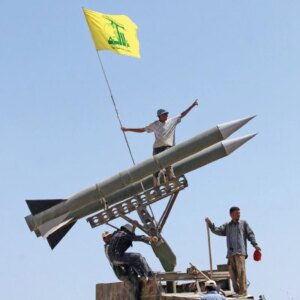
As for missiles and drones, he points out that “Hezbollah’s move to a range exceeding 200 kilometers constitutes a remarkable shift, as it allows targeting the Israeli depth in the north and center,” and imposes an equation that says: “The more pressure on the ground increases, the more the response expands deeper.”
On the other hand, he explains that “Israeli superiority remains clear in the air and intelligence, through carrying out precise strikes targeting commanders and stores, in addition to continuous targeting of the command and logistical structure.”
Regarding the balance of power, Halal explains that “Hezbollah has so far succeeded in preventing a rapid ground victory, as Israel has not been able to achieve easy progress or establish deep control. It has also maintained the pace of fire despite the strikes, which reflects a high endurance capacity.” He added, “Expanding the targeting range to more than 200 km has deterrent and psychological value.”
On the other hand, it indicates the presence of weaknesses, most notably human and leadership losses, even if they were not fully announced, in addition to complete Israeli air superiority, as well as increasing pressure on the incubating environment as a result of displacement, destruction, and economic pressures.
As for whether the field has witnessed a real shift in favor of Hezbollah, Halal answers precisely: “Not yet,” explaining that what is happening is a transition from a purely defensive situation to a “balance of attrition,” where the party is no longer in a state of rapid decline, but at the same time it has not imposed a clear victory equation.
He identifies three basic conditions for talking about a shift towards victory: first, a clear cessation or failure of the Israeli ground advance, second, the continued ability to strike the Israeli depth in a painful and continuous manner, and third, the imposition of a new deterrence equation that links any ground advance to qualitative strikes in the depth.
He points out that these conditions have not yet been met, as the first condition has been partially fulfilled, the second is still limited and calculated, while the third condition has not been fully established.
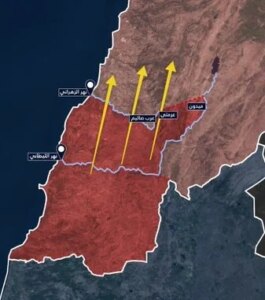
Regarding field developments, Halal focuses on the eastern axis extending between Khiam, Taibe, and Deir Seryan, describing it as one of the most sensitive and complex axes, due to the combination of relatively open geography and high fire control.
In Khiam, he explains that it overlooks a wide plain towards the Israeli interior, is located near sensitive military sites, and constitutes a connecting point between the Lebanese interior and the border, making it a key to any eastern ground advance, and controlling it means exposing the rear lines of the resistance.
As for Taybah, it is a direct point of contact, representing the first line of engagement, and controlling it provides an advanced fire platform. While Deir Siryan constitutes a defensive logistical node in depth, its fall opens the way to threatening wider areas such as Nabatieh and Zahrani.
Halal asserts that “superiority in this axis is distributed between the two parties, as Israel has the advantage in the air, reconnaissance, precise bombing, and destructive ability, while Hezbollah excels in close combat, carrying out ambushes, and knowing the land, in addition to the ability to absorb shock.”
Strategically, Halal believes that this axis will determine the course of the confrontation: either Israel succeeds in imposing a buffer zone that distances the party from the border and reduces the threat, or it turns the region into a “swamp of attrition” similar to what the south was in before 2000.
He concludes that the Khiam-Taybeh-Deir Saryan axis is more an “axis of testing will” than an arena for a quick resolution, as Israel is trying to advance without sinking, while Hezbollah seeks to prevent a resolution without fully revealing its capabilities.
The current result, according to Halal, is clear: no resolution… but rather heavy attrition, and whoever endures the longest and breaks the balance first is the one who will win this axis.